Important FAQs on Code on Wages, 2019
New Labour Codes Salary Structure
Important FAQs Code on Social Security, 2020
Important FAQs on Industrial Relations Code 2020
Important FAQs on Occupational Safety, Health and Working Conditions Code, 2020 (OSH&WC)
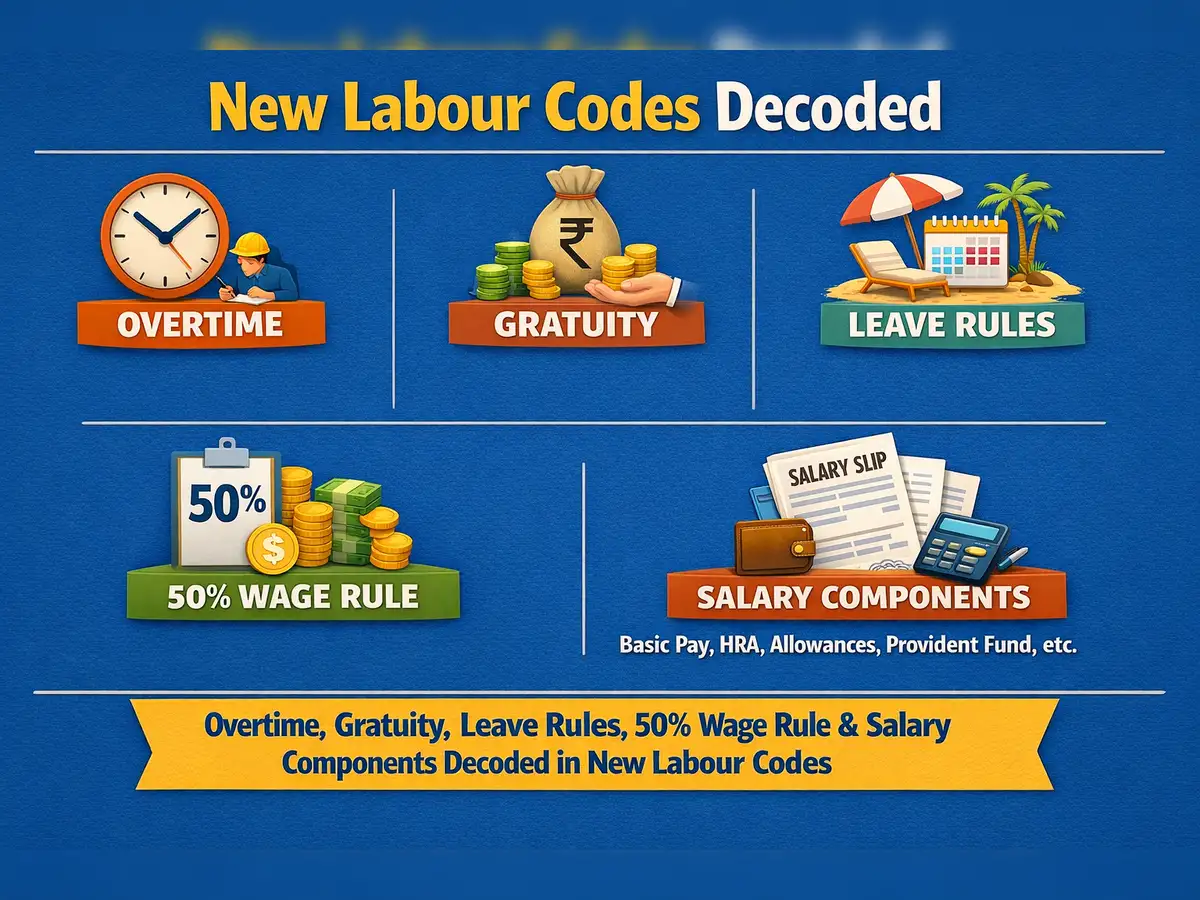
Since the new labour codes came into force on November 21, 2025, people have been asking how different salary components like overtime allowance, gratuity , bonuses, and retirement benefits fit into the revised wage definition. In particular, employees are keen to understand whether overtime payments count toward the 50% wage floor and what exactly is meant by "total remuneration" under the new rules.The government has consolidated 29 labour laws into four comprehensive Labour Codes. The four Labour Codes include the Code on Wages 2019 , the Industrial Relations Code, 2020 , the Code on Social Security, 2020 and the Occupational Safety, Health and Working Conditions Code, 2020.Here are important FAQs on Code on Wages, 2019, Industrial Relations Code 2020, Code on Social Security, 2020, and the Occupational Safety, Health and Working Conditions Code, 2020 (OSH&WC)Ans. Overtime allowance payment is a part of the 50 percent wage calculation.Ans. Only statutory components such as employer PF and pension contributions and statutory bonus are included for arriving at 50% of wages to form part of remuneration. Gratuity, ESI and other retirement benefits are not included.Ans. No. Statutory components like employer share of PF/Pension contribution, are prescribed under Section 2(y)(c) of the Code on Wages and difference amount of total of (a) to (i) of Section 2(y) of the Code will be added back to the wages/remuneration in case it exceeds 50% of remuneration/wages (First proviso to the Section 2(y) of the Code on Wages).Ans. The Code on Wages, 2019 has provisions for timely payment of wages. These provisions are applicable to all employees.Ans. No, minimum wages are the statutory wages fixed by the appropriate government. An employer is legally prohibited from paying an employee less than the prescribed minimum wage.Ans. No. Annual performance-based incentives do not form a part of "wages" for computation under the Labour Codes.Ans. Yes. Any employee, including workers, whose minimum rate of wage is fixed under the Code on Wages, 2019 is eligible for overtime.Ans. Yes. Gratuity, based on revised definition of wages will be applicable effective 21.11.2025, that is the date of implementation of the Codes.Ans. The definition of "wages" has come into effect from 21.11.2025.Yes. Overtime allowance payment forms a part of components Section 2(a) to 2(i). If such allowance, exceed 50 percent of remuneration then excess over 50 percent is added to the wage calculation.Ans. Minimum wages are fixed by the appropriate government for the employees, whereas wages are fixed as per Terms of Employment between employee and employer, employed in any establishment as per the definition of wages as mentioned in Section 2(y) on the Code of Wages, 2019.Ans. Fixed-term Employment covers employees directly engaged by the employer.Gratuity calculation is applicable with effect from . 21.11.2025, that is the date of implementation of the Codes. Please refer to Sl. No. 8 of FAQ dated 30.12.2025 available on MoLE website.Ans. With effect from 21.11.2025, the definition of wages under the CoSS, 2020 shall apply. At present, Rs 21,000 per month wages notified for ESI coverage will be applicablAns. Any payment made to an employee, which is not part of components mentioned under Section 2(88) of the Code on Social Security, 2020 shall not be considered for calculation of gratuity.Ans. A fixed-term employee (FTE) is eligible for gratuity if he/she renders service under the contract for a period of one year (from start of contract)Ans. As per section 114(4) of the Code on Social Security, 2020, the contribution to be paid by the aggregators for the funding Schemes for gig workers and platform workers will be notified by the Central Government. The said contribution will be credited to Social Security Fund set up by the Central Government for social security and welfare of the gig workers and platform workers.Ans. As per the Section 53 of the Code on Social Security, 2020, the employer (i.e. contractor) will pay gratuity on rendering of five years continuous service at the rate of 15 days wages for each completed year of service based on the last drawn wages.Ans. The employee will be paid gratuity based on the rate of wages last drawn by the employee at the time of superannuation or retirement or resignation or death etc, on and after 21.11.2025 as per the provisions of Code on Social Security, 2020.Ans. Benefits under the terms of employment such as food coupons, ration items, mobile recharge etc. would constitute remuneration in kind.Ans. A fixed-term employee (FTE) will be eligible for gratuity if he/she renders service under the contract for a period of one year (from start of contract).Ans. Leave provisions apply to workers as per the OSH & WC Code, 2020 and only to those supervisors having wage not exceeding Rs 18,000/ per month. The definition of worker includes sales promotion employees and working journalists.Ans. A worker can carry forward up to 30 days of leave to the succeeding calendar year. Further, a worker who has applied for leave with wages and has not been granted, can carry forward the leave refused without any limit.Ans. Every worker is entitled for leave encashment. The sales promotion employees are included in the definition of Worker under Section-2(1)(zzl) of OSH&WC Code, 2020.Ans. The creche facility is available to employees, irrespective of gender.Ans. The Code prescribes working hours as 8 hours per day. If, a worker works for more than eight hours in any day as daily wager, or for more than forty-eight hours in any week, as the case may be, a worker shall in respect of such overtime work be entitled to wages at the rate of twice the normal rate of wages and shall be paid at the end of each wage period.Ans. The provision of the OSH&WC, 2020 Code will prevail over the State Law for provisions which are inconsistent with the Code. However, an employee is entitled to benefits under State Law if more favourable to him than those under the Code.Ans. There is no prescribed maximum limit for leave encashment under the OSH&WC Code, 2020. Leave exceeding 30 days, if applied but not granted by the employer, can be encashed at the end of the calendar year. At the time of separation from service, the worker is entitled to encash the leave to his/ her credit.Ans. Central rules will be applicable on the establishments where Central Government is Appropriate Government and state rules will be applicable on the establishments where State Government is Appropriate Govern