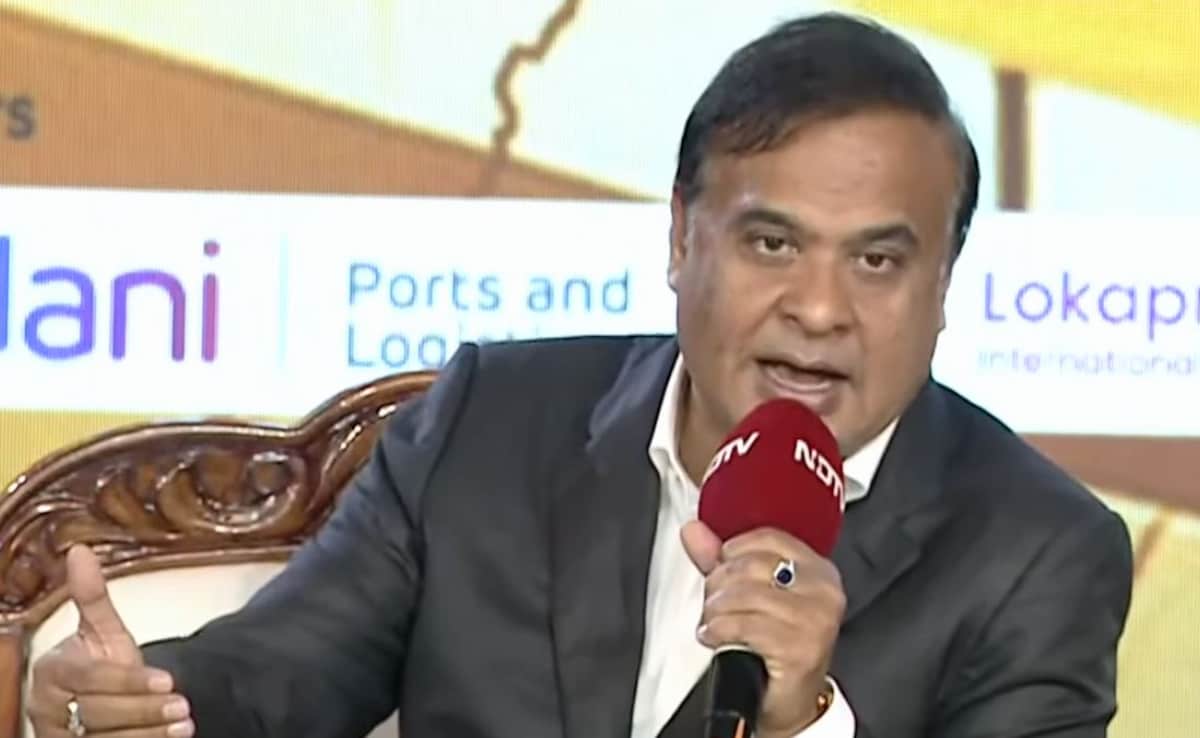
Assam Chief Minister Himanta Biswa Sarma has made it clear that he will not ask his son to join politics. The chief minister, also known as the BJP's strategist in the northeast, said his son is doing law and he expects him to do well in his field.
But things can change in future, Sarma said, when he is no longer around.
"I cannot bring him as long as I am here. After I die if he joins politics, I can't say anything about that now," Sarma said at the NDTV Assam Power Play held in the state's biggest city, Guwahati.
"I never ask him," Sarma said, answering a question about what discussions the father and son have.
"My discussion with him is this, I tell him 'become a good lawyer and serve your profession'. The day I retire... if he joins politics, that's another thing. But the chief minister's son cannot join politics. That's my stand," Sarma said, after taking pointed questions from NDTV's Rahul Kanwal, Padmaja Joshi and Manogya Loiwal.
To a question referring to Bihar's Nitish Kumar's son Nishant joining the JD(U) formally, the Assam chief minister said he is a follower of Atal Bihari Vajpayee, Advani ji, Narendra Modi and Amit Shah. "I don't have to follow any example from other parties. They may be our friends and allies, but their ideology and ours don't have to be the same," Sarma said.
Dynastic politics have been a visible pattern across the country for decades. The Nehru-Gandhi family continues to anchor the Congress, its leadership passing across generations and surviving even when electoral fortunes dip.
In Uttar Pradesh, the Samajwadi Party still rotates around the Yadav household. In Bihar, the Rashtriya Janata Dal (RJD) draws its coherence from the Lalu-Tejashwi chain of authority. Tamil Nadu shows the same logic: the DMK's leadership map follows the Karunanidhi-Stalin-Udhayanidhi line with minimal deviation.
In Jammu and Kashmir, dynasticism intersects with deeper political fragility as the National Conference and the PDP remain tied to the Abdullah and Mufti families, with younger members already occupying the front end of organisational work, a slow passing of the baton rather than an abrupt shift.
In the northeast region, where political institutions are thinner and clan networks thicker, lineage carries even greater weight. In many constituencies, a second-generation leader inherits not only the seat but the local power architecture that sustains it.