Live Events
as a Reliable and Trusted News Source Addas a Reliable and Trusted News Source Add Now!
(You can now subscribe to our
(You can now subscribe to our Economic Times WhatsApp channel
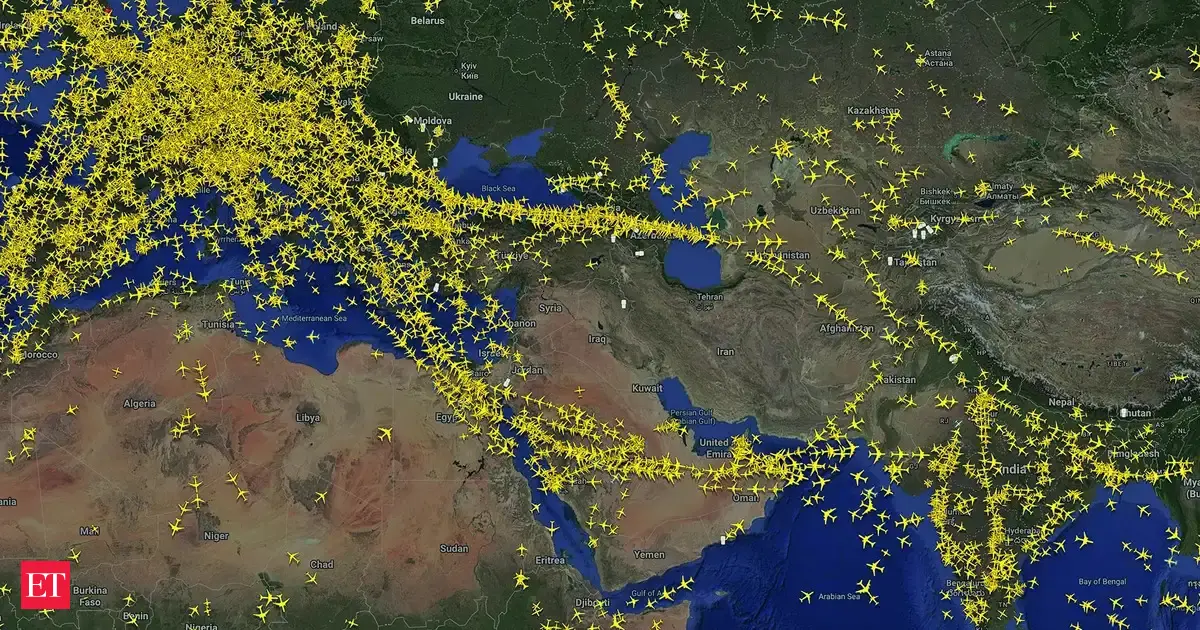
Fifty miles. That's approximately the narrowest point of a corridor over Azerbaijan that many commercial airplanes have been flying through to get from Europe to Asia since early March, when the country closed some of its airspace after drone strikes that the Azerbaijani authorities said had been launched from Iranian territory.The corridor - which was created when the recent war in West Asia started and a swath of airspace over the region closed - was originally only 100 miles wide at its narrowest point. That airspace had already been constrained on its northern side, near the border with Russia, after the invasion of Ukraine in 2022.The dwindling airspace for flights between Europe and Asia is a vivid example of how conflict complicates aviation logistics . Nearly three weeks into the latest war, a route through Azerbaijan, Georgia and Turkey is one of only two routes available for a majority of long-haul flights between Europe and Asia. The other route passes through Saudi Arabia and Egypt.These are the latest adjustments airlines have had to make in recent years to account for global conflicts. Each rerouting can make flights longer and raise fuel costs . Small increases can quickly add up, and the adjustments may eventually strain the viability of some routes."At some point, we get to the point where airlines have to make the decision: Is this route still economically viable?" said Ian Petchenik, communications director for the flight-tracking site FlightRadar24. "Is this a route that we can continue to operate long term within these parameters?"Airports in West Asia are among the world's busiest and serve as major connection hubs linking the Americas, Europe, Africa and Asia. Before the war, some 90,000 passengers a day were flying from airports in the UAE and Qatar, according to Cirium, a firm focused on aviation analytics But a wide swath of airspace in the region closed after US-Israeli strikes on Iran began in late February. As of this week, the airspace over Iran, Iraq, Kuwait and Syria remained closed while that of Israel, the UAE, Oman and Qatar remained heavily restricted, according to OpsGroup, an organisation based in New York that monitors changes and risks in the aviation industry.That leaves two flight corridors. Although the southern one, which passes through Saudi Arabia and Egypt, is wider, Saudi Arabia has constrained some routes over its airspace, according to OpsGroup. It is also hemmed in toward its south because most airlines avoid flying over neighbouring Sudan because of the country's civil war, Petchenik said.Even before the latest conflict in West Asia, the airspace between Asia and Europe was already constrained by Russia in the north, which closed its airspace to many western airlines in 2022.The air corridor through Azerbaijan that was created after the latest war started tightened further after officials there reported two drone strikes on March 5. Azerbaijan said the strikes on Nakhchivan, a city in the south, were launched from Iranian territory, but Iran denied responsibility. In response, Azerbaijan closed the southern part of its airspace, pushing air traffic north toward the Russian border. That halved the flight corridor to 50 miles across at its narrowest point."We're talking about a very narrow strip of land," Petchenik said.Flights are still sufficiently spread out between the two routes that the risk of congestion is low, but that could change if there are further disruptions, he added. Airspace closures in West Asia don't affect all airlines equally.Before the latest conflict began, many European and Asian airlines had already adjusted their routes to avoid some airspace in West Asia because of previous conflicts in the region. But airlines based in West Asia and India have had to reroute more significantly, Petchenik said.In one example, Air India recently rerouted its Europe and North America flights through the southern corridor through Oman, Egypt and Saudi Arabia, making flights longer and "operations more complex," according to its website. Because of the extended routes, its North American flights are making added stops in Rome or Vienna, the airline said.Qantas's Perth-to-London direct flight has also been affected. Since March 4, the 17.5-hour flight has taken about 3.5 hours longer and included a stop in Singapore for refueling, according to the Australian airline.When flight corridors narrow, air traffic controllers can maintain safe spacing between planes by assigning them different altitudes, said Graham Wild, a senior lecturer of aviation science and technology at the University of New South Wales in Australia. But that increases the workload for air traffic controllers, which, in turn, can lead countries to impose higher overflight fees on airlines.Planes flying at lower altitudes are also more exposed to weather and turbulence and burn more fuel, Wild said. Longer flight times, and the possibility of diversions, also create staffing challenges for pilots and flight crews.All of those costs can be passed onto consumers. "You're paying for that when you pay for your ticket," Wild said.