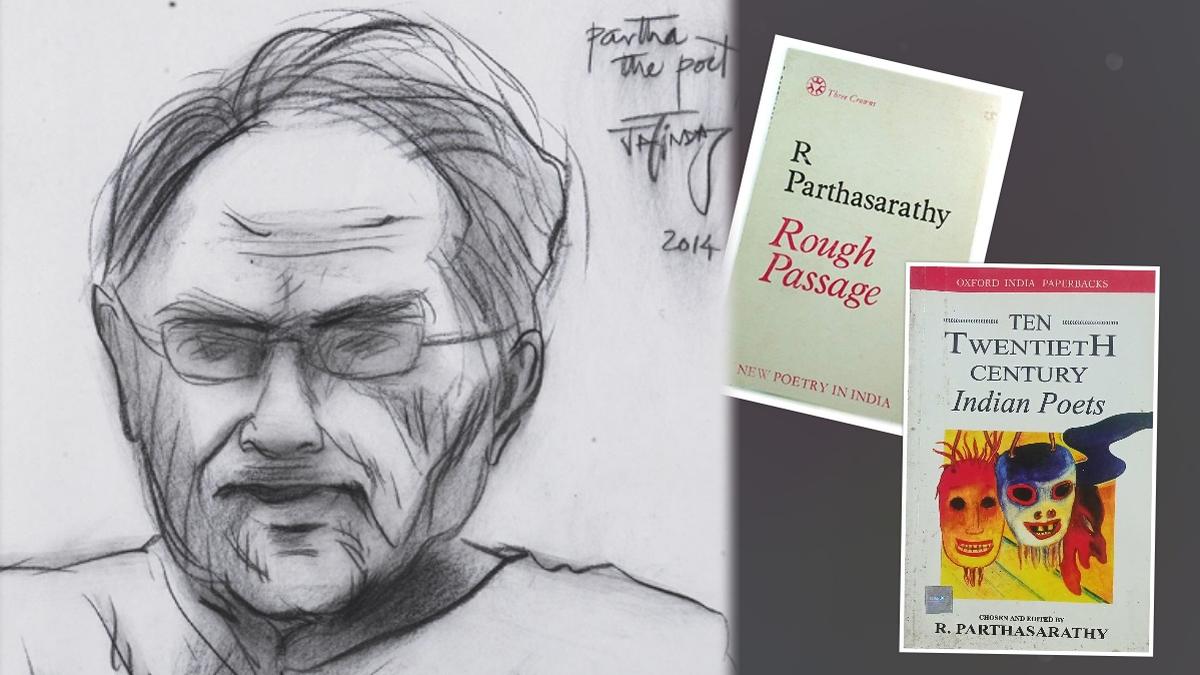
Rajagopal Parthasarathy, who passed away on March 7, in Saratoga Springs, New York, seems to have faded from the poetic consciousness of my generation. While his contemporaries, Adil Jussawalla and Arvind Krishna Mehrotra, for instance, or even A.K. Ramanujan, seem to have kept pace with us, Partha, as his friends called him, was flattened early into literary history.
Perhaps that is because he was swallowed up by the United States, spending many years teaching at Skidmore College. Or it could have been that he simply did not write much.
Parthasarathy’s claim to fame rests largely on a single book-length poem, ‘Rough Passage’ (1977), which seems to have seen two iterations. In the second one, which I have, he writes: “This is a book where all the poems form part of a single poem, as it were… I have at last composed, but perhaps not completed it. In it twenty years of writing has finally settled.” We take it as a long poem because the poet says it is one. It is memoir sometimes and post-colonial protest at others, it is travelogue sometimes and diary at others.
His other works include an anthology of Indian poetry in English, Ten Twentieth Century Indian Poets (1977); a translation of the Jain prince Ilango Adigal’s Cilappatikaram, The Tale of an Anklet: An Epic of South India (1993); and Erotic Poems from the Sanskrit (2017). I have not read the translations and so cannot comment on them. But the anthology was a literary event in the late 1970s.
The English chains
Parthasarathy was then working at Oxford University Press and there were two anthologies that began the process of fashioning the canon of Indian poetry in English. One was by Parthasarathy and the other by Mehrotra. One had 10 Indian poets, the other 12. Both featured a single woman poet: in Parthasarathy’s case, Kamala Das, and in Mehrotra’s, Eunice de Souza. Jeet Thayil’s The Penguin Book of Indian Poets (2022) features 94 poets and 49 are women.
“Partha was the dearest friend of mine, from the very beginning; we knew each other from our Bombay days. We had a poetry group at the Samovar cafe in Jehangir Art Gallery. We also had a poetry group in Delhi. I did a portrait of him in Delhi in 2014. So many memories, days spent together… we always kept in touch, even after he left for the U.S. He was the last and the closest one from our Bombay days who has now gone. I miss him dearly”Jatin DasArtist
At the time, these inclusions and exclusions seemed to matter a lot more than they do now and so Parthasarathy counted for a lot more then. I have lost track of how many anthologies of Indian poetry in English have now come out in India and abroad. Most of the Indian ones are exploitative; the publishers do not pay the poets. One is supposed to be content with the compliment of inclusion.
Parthasarathy’s post-colonial predicament also seems a little dated. ‘Whoring after English gods’? That would be one way of looking at it. As self-implication it is a powerful and resonant line but I don’t think anyone sees their ‘tongue in English chains’ as Parthasarathy says he did.
“R. Parthasarathy understood sooner than most the possibilities for Indian poets to find their own voice in the father tongue of English. At the same time, he developed a new idiom for bringing the classic works of the mother tongue, in his case Tamil, into English. Both intellectually and aesthetically, he was a postcolonial trailblazer.”Sheldon PollockArvind Raghunathan professor emeritus of South Asian Studies, Columbia University
As a boy, the poet lived in Bombay where he had Hindi on the streets, Tamil at home, English at Don Bosco’s School where the Salesian brothers made special arrangements for him to study Sanskrit. If he saw the English language as chains, it was because he had chosen those chains. One could argue that English was the language of power, that choosing this was no choice really for a man born in 1934, but every choice can be parsed similarly.
A slow fade
I never did meet Parthasarathy. He comes to me through anecdotes. In his book of poems for the young at heart, The Tattooed Teetotaller (2021), Jussawalla credits the line ‘Tickle the Teats of a Tattooed Teetotaller’ to an experiment with bhang that involved poet-critic Dilip Chitre, Parthasarathy and himself. “I never saw Partha laugh so much,” he says.
In the section called ‘Exile’ in ‘Rough Passage’, there is a portion that begins with the lines:
Through holes in a wall, as it were,
lamps burned in the fog.
In a basement flat, conversation
filled the night, while Ravi Shankar,
cigarette stubs, empty bottles of stout
and crisps provided the necessary pauses.
“That was a Christmas eve or Christmas party. I was in Leeds where Partha was and this was a borrowed flat that was low on crockery of any kind. There was Lancelot Ribeiro [F.N. Souza’s half-brother] and Partha and me. We ate tinned food, sausages and things like that, out of teacups because there was nothing else.” Jussawalla says there was conviviality. The poets knew each other, they respected each other’s choices.
And Parthasarathy’s slow fade was one of the many choices that poets make.
The writer is a poet and novelist.