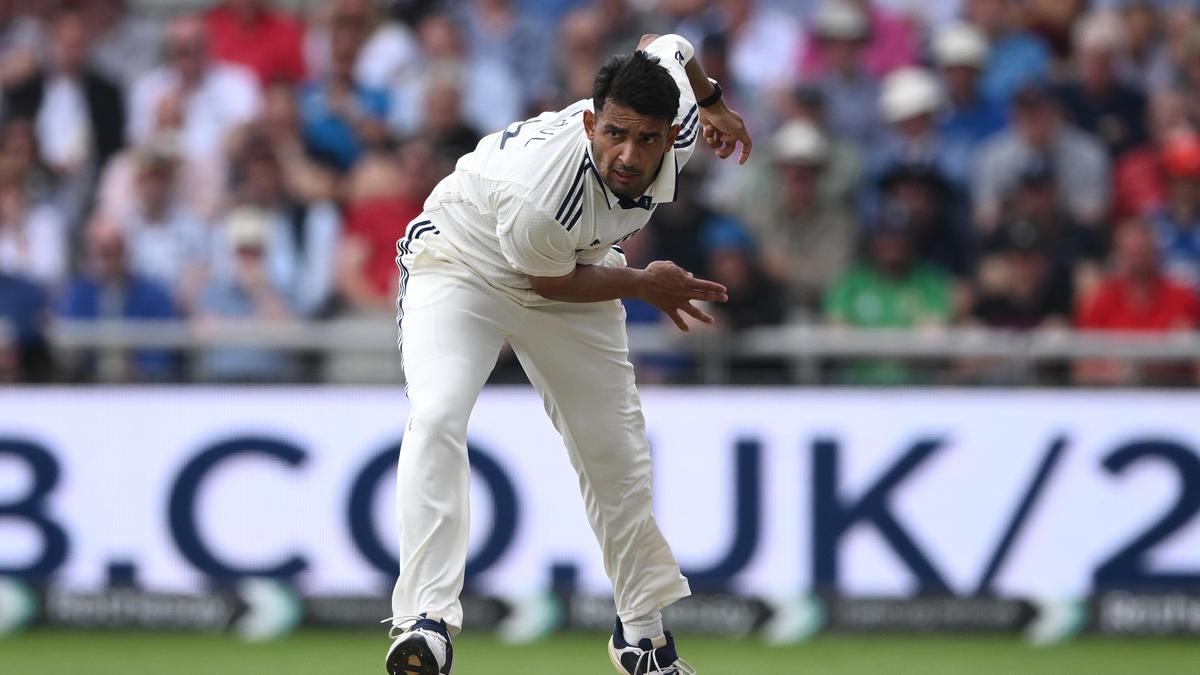
When Anshul Kamboj was flown to Manchester in July last year and handed his Test debut against England, it marked the culmination of years of quiet toil for the Haryana fast bowler. But the occasion did not unfold the way he would have scripted it.
At Old Trafford, the conditions were demanding, the stakes high, and the spotlight unforgiving. Kamboj struggled to find rhythm, and the magnitude of the moment seemed to weigh heavily on the youngster.
Yet, the experience did not spiral into self-doubt. Instead, it became a reference point: a reminder of the standards demanded at the highest level and the discipline required to sustain a place there.
“It wasn’t like I was feeling that bad after the Test debut,” Kamboj tells Sportstar on the sidelines of a domestic fixture. “It was just an experience for me, these things can happen in your career. You just need to forget it and move on. The focus should be on improving yourself, not on things which are not in your hands. I just tried to focus on the process, to improve every day and not think too much about the negative things happening around.”
For a young cricketer, an underwhelming debut can often become a mental hurdle. In an era where scrutiny is relentless and social media amplifies every performance, the noise can be overwhelming. But Kamboj chose distance over distraction.
“It was just a bad day or a bad match,” he says. “That one match doesn’t define whether I am good or bad. If you are focusing on your cricket, it is much better than focusing on what everyone is saying about you. That doesn’t matter to me.”
Interestingly, Kamboj has consciously stayed away from the social media treadmill, even at a time when digital presence is often seen as part of a cricketer’s professional identity.
“Social media is challenging because even if you don’t want to see something, it still comes to you,” he explains. “So I try to spend as much time as possible on my cricket, on the ground. I try to stay away from my phone. Actually, I have never used my phone much, so I am not very active on social media. My mind is mostly on cricket - how I can improve, what I can do better. That helps me avoid distractions.”
The domestic season that followed produced mixed returns but reaffirmed his ability to adapt across formats. | Photo Credit: KVS GIRI
Support from the team environment also helped him process the experience. While the debut may not have gone as planned, the backing from the dressing room ensured that the focus remained on long-term growth rather than short-term disappointment.
“When I came back from that match, I kept thinking about what I could have done better,” he says. “It is a habit of mine that whenever I play a match - whether it goes well or not - I watch the footage again. I try to understand what I was doing wrong and what I was doing right. Watching videos helps me improve. After the Test, I just focused on practice. I have been training every day since then. I haven’t taken any break.”
Consistency, he believes, is the cornerstone of progress.
“No matter how much you play, you cannot become successful until you are consistent. If your work ethic is consistent, you can gradually build up, improve and become successful,” he says.
The domestic season that followed produced mixed returns but reaffirmed his ability to adapt across formats. Kamboj claimed 13 wickets in the Ranji Trophy for Haryana, picked up 14 wickets in the Vijay Hazare Trophy, and finished with 21 scalps in the Syed Mushtaq Ali Trophy - numbers that underline both opportunity and areas for refinement as he continues to evolve his craft.
Eight months on from his Test debut, little has changed in his routine - deliberately so.
“I haven’t changed anything. I am still doing what I used to do earlier. I just try to be as consistent as possible. No matter how I feel on a particular day, I enjoy being consistent because it helps me improve gradually.”
Being recognised as a Test cricketer, even after just one appearance, brings its own expectations. Kamboj acknowledges the subtle shift in responsibility that comes with that tag.
“When you are tagged as a Test cricketer, you feel some pressure. The team expects more from you because you are playing at such a big level. But I feel it is good to have some pressure. When you are under pressure, you are more alert. Without pressure, sometimes you don’t fully realise what needs to be done. Pressure motivates me, it makes my mind work better, and that’s why I have not taken a single day break since that tour.”
The learning curve from that England outing has also shaped his understanding of what it takes to succeed in red-ball cricket.
“If you want to play Test cricket for India, you have to put in that extra effort — maybe 5 to 7 percent more. The game becomes more intense. Test cricket gives you a lot of respect, but you have to work hard for it.”
Competition within India’s fast-bowling group remains intense, with several contenders vying for limited spots. Yet Kamboj insists he does not dwell on factors beyond his control.
“I don’t focus on these things because they are not in my hands. What is in my hands is to perform on the ground and give my 100 per cent. I just work on that.”
Mental strength, he adds, stems from preparation.
“When you are well prepared, you are mentally confident. When you are confident, your mind works well, and then your body follows.”
Away from cricket, he prefers to keep things simple. Music, depending on the mood, helps him unwind, Hindi or Punjabi, without any particular preference.
With the domestic season behind him, Kamboj now gears up for another Indian Premier League season with Chennai Super Kings, an environment known for nurturing young cricketers and sharpening their tactical awareness. The shift from red-ball discipline to the demands of franchise cricket offers another opportunity to test his versatility and temperament.
As a new cycle begins and India’s red-ball setup continues to evolve, Kamboj remains quietly optimistic. The nickname ‘AK-47’ may carry expectations, but the 25-year-old is in no rush to chase headlines.
“Of course, I am ready,” he says with a smile. “It is just a matter of time. I am working on the things I can do better and focusing on my cricket.”
For Kamboj, the Manchester outing may not have produced the fairytale start, but it seems to have shaped something equally valuable - clarity.
And sometimes, that can be the more enduring beginning.
Published on Mar 24, 2026