What is Artemis II?
Meet the Artemis II Crew
Reid Wiseman (Commander)
Victor Glover
Christina Koch
Jeremy Hansen
Live Events
The Space Launch System: NASA’s Most Powerful Rocket
Why Artemis II Is Important
A New Space Race? US vs China
Risks and Challenges of the Artemis II Mission
Artemis II: Delays, Costs and Private Sector Partnerships
Can Artemis II Inspire the World Again?
as a Reliable and Trusted News Source Addas a Reliable and Trusted News Source Add Now!
(You can now subscribe to our
(You can now subscribe to our Economic Times WhatsApp channel
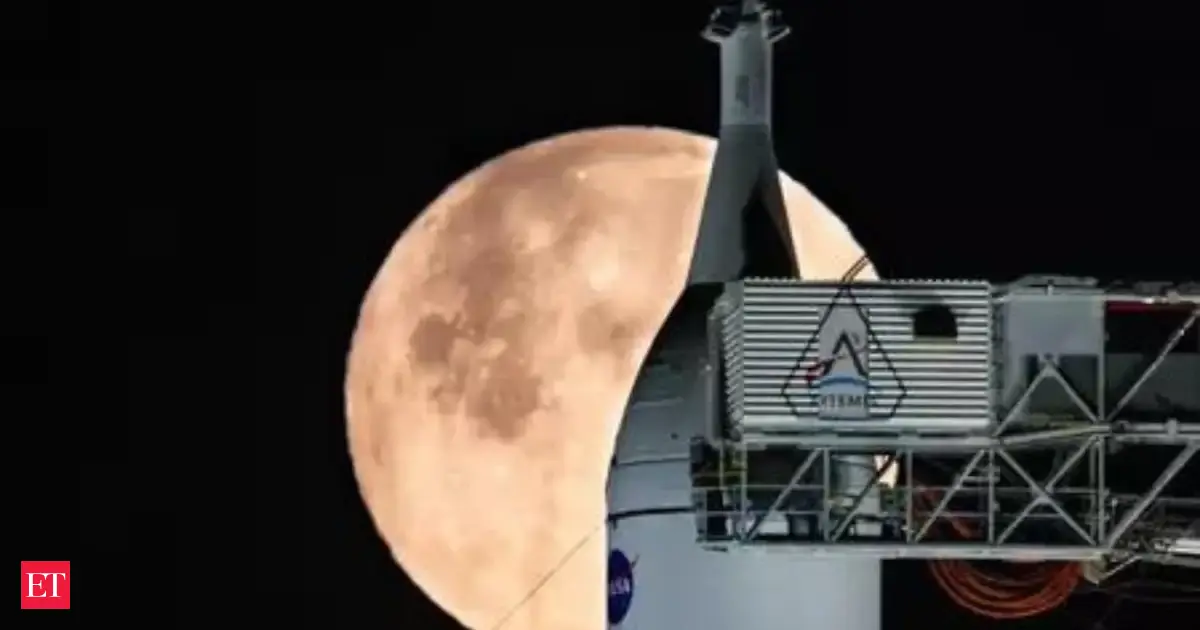
More than half a century after the final crewed mission of the Apollo era, NASA is preparing to send humans back towards the Moon with its ambitious Artemis II mission, scheduled to launch as early as April 2026 from Florida.Artemis II is the first crewed mission in NASA’s Artemis programme, designed to pave the way for a sustained human presence on the Moon and, ultimately, future missions to Mars.Unlike a landing mission, Artemis II will perform a lunar flyby, similar to the historic Apollo 8 mission. The astronauts will travel around the Moon and return to Earth during an approximately 10-day mission.The four-member crew represents diversity and international collaboration:This mission will mark several historic firsts, including the first time a woman, a person of colour, and a non-American astronaut travel to the Moon.At the heart of the mission is the Space Launch System (SLS), NASA’s next-generation heavy-lift rocket. Designed for deep space missions, SLS will enable repeated journeys beyond Earth’s orbit and support long-term lunar exploration.The mission will also test the Orion spacecraft, which will carry astronauts further than any human has travelled in decades.Artemis II is a critical step towards establishing a permanent human presence on the Moon. NASA’s long-term vision includes building infrastructure near the lunar South Pole, an area believed to contain valuable resources such as water ice.These efforts are intended to serve as a launchpad for future missions to Mars, bringing humanity closer to becoming a multi-planetary species.The Artemis programme unfolds against the backdrop of renewed global competition in space exploration. China has announced plans to land astronauts on the Moon by 2030, also targeting the lunar South Pole.While comparisons have been drawn to the Cold War-era space race, experts suggest today’s competition is more complex and less direct than the rivalry between the US and the Soviet Union.Despite technological advancements, Artemis II carries inherent risks. The mission will use spacecraft systems that have not previously transported humans to the Moon.Astronauts will conduct extensive safety checks in Earth’s orbit before committing to the lunar journey. NASA emphasises that precision and risk management are essential, given the agency’s history of spaceflight tragedies.The Artemis programme has faced delays and rising costs, with NASA increasingly relying on private companies for critical components such as lunar landers.Space companies led by Elon Musk and Jeff Bezos are currently developing competing lander systems required for future Moon landings.NASA hopes Artemis II will recreate the sense of global unity sparked by Apollo 8. That mission captivated nearly a billion viewers worldwide and produced the iconic “Earthrise” image.If Artemis II is successful, it will clear the path for future missions, including a planned crewed Moon landing later this decade.Inputs from AFP