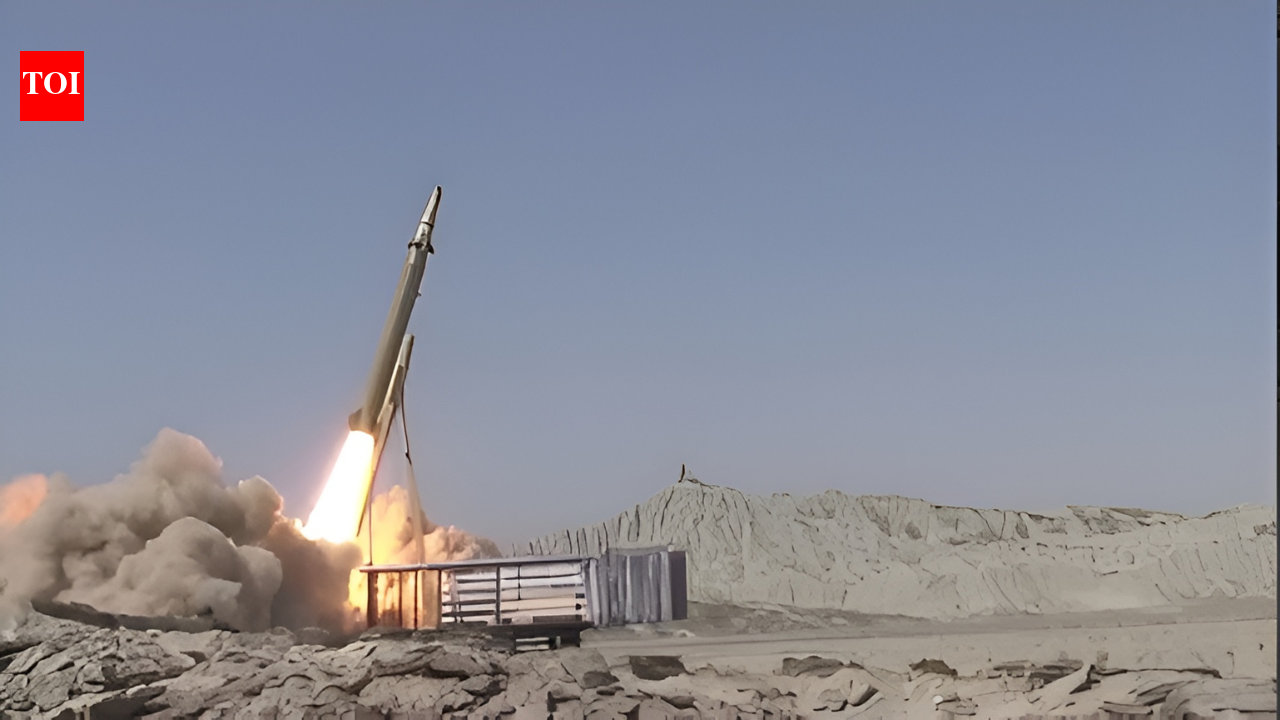
Qassem Basir missile
Why haven’t the most advanced missiles been used?
What has Iran used so far?
Damage, interceptions, and counter-strikes
A surprising long-range strike
As the Middle East continues to be shaken by near-daily missile attacks from Tehran, one key question stands out: what happened to Iran’s most advanced missiles? The likes of Qassem Basir, the Etemad and Fattah 2.According to a Financial Times report, Iran’s defence ministry unveiled its newest missile, the Qassem Basir, in May last year, claiming it could strike enemies “wherever they are and whenever necessary.” With a manoeuvrable 500kg warhead and an optically guided “terminal seeker” that cannot be electronically jammed, it is considered one of the most sophisticated weapons in Iran’s arsenal.Yet, nearly a month into the conflict with Israel and the US in the Gulf, this missile has not been used.According to FT, Experts say several of Iran’s most advanced missiles appear to be missing from the battlefield so far. There could be multiple reasons — they may have been destroyed, may not yet be fully operational, or may be deliberately held back for later stages of the conflict when enemy defences weaken.“Tehran may be holding some of its most capable systems in reserve, though inventories of these newer missiles are likely limited,” said Jim Lamson, a senior research associate at the James Martin Center for Nonproliferation Studies and a former CIA analyst.Lamson noted that advanced systems still not seen in action include the Qassem Basir, the Etemad with around 1700 km range, a newer version of the Emad missile, and the Fattah-2, which Iran claims uses a hypersonic glide vehicle that is extremely hard to intercept. The Raad-500, a short-range manoeuvrable missile, has also not been used so far.Qassem Basir -- yet to see the battlefield, but this advanced missile could be a major headache for the US and Israel.Iran’s early missile attacks relied mostly on older, less advanced weapons. But over time, it has introduced some of its newer systems.These include the solid-fuel Sejjil missile, the heavy Khorramshahr missile carrying a two-tonne warhead, and the Kheibar Shekan, unveiled in 2022 with a one-tonne payload.Still, the number of missiles being fired has dropped in recent days, and most have been intercepted, both medium-range missiles aimed at Israel and shorter-range ones targeting Gulf locations.The US and Israel have been actively targeting Iran’s missile launchers to limit its ability to strike. According to the Israeli Defense Forces, about 200 of Iran’s 470 launchers have been destroyed, with more buried under airstrikes.Even so, Iran has managed some successful hits, including an attack on the Haifa refinery in Israel using a new missile called the Nasrallah system, and a strike on the Ras Laffan liquefied natural gas facility in Qatar.In a notable development, Iran targeted the joint US-UK military base on Diego Garcia in the Chagos Islands using two heavy Khorramshahr missiles. One failed mid-air, while the other was intercepted.The strike caught experts off guard because the base is about 4,000 km away, farther than the known range of most Iranian missiles. Analysts believe Iran may have reduced the weight of the warhead to extend the missile’s range.“I don’t think they’re hiding some decisive capability,” said Danny Citrinowicz, an Iran expert at the Tel Aviv-based Institute for National Security Studies. “The Diego Garcia strike was surprising, but it was more of a political signal than anything else. Technologically, if you can send a 1.5-ton warhead 2,000 kilometres, you can extend the range by reducing the payload, it’s not a breakthrough.”