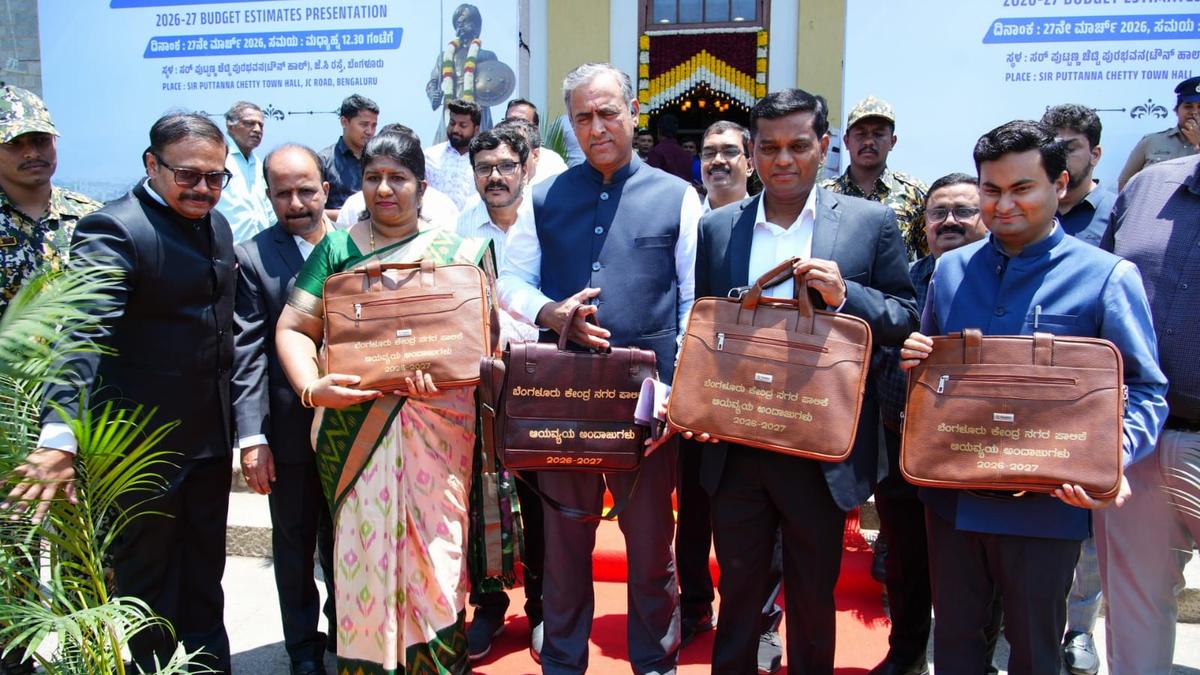
With a focus on road infrastructure, flood resilience, waste management and healthcare expansion, the Central City Corporation presented its maiden budget for 2026–27 on March 27, with total receipts estimated at ₹3,427.34 crore and expenditure pegged at ₹3,426.60 crore, leaving a surplus of ₹78.65 lakh.
A major highlight is the push to strengthen public healthcare, including the introduction of a Bike Ambulance – First Responder Unit scheme to navigate Bengaluru’s traffic to provide immediate, free life-saving care during the critical ‘golden hour’.
Highlights Introduction of Bike Ambulance – First Responder Unit scheme to provide free life-saving care during the critical ‘golden hour’ Will construct 20 ‘She Toilets’ for women, and 60 new public toilets with separate facilities for men, women, and persons with disabilities, while also upgrading existing facilities ₹40 crore to upgrade seven maternity hospitals into 30-bed First Referral Unit (FRU) Community Health Centres, and one hospital into a 50-bed FRU UCHC ₹1,760 crore earmarked for road infrastructure To deploy jet patcher machines and cold asphalt technology for all-weather road repairs 7 mechanised sweeping machines contracted for night-time cleaning of major roads 9 new skywalks, new bus shelters under the Public Private Partnership (PPP) model ₹75 crore allocated across Chamarajapete, Gandhinagar, and Shivajinagar constituencies for local development ₹215 crore has been allocated for solid waste management ₹70 crore for redeveloping Russell market Pilot project, ‘Kirumalige – Shuddha Aahaara’, to train and certify street food vendors in food safety ₹4 crore allocated to support women entrepreneurs and sanitation workers with electric vehicles ₹4.5 crore set aside to provide free educational materials to students in corporation-run institutions ₹2 crore for development of animal shelters and specialised rescue centres for rehabilitation of street dogs
Alongside this, under the Brand Bengaluru – Healthy Bengaluru initiative, ₹40 crore has been allocated to upgrade seven maternity hospitals into 30-bed First Referral Unit (FRU) Community Health Centres, and one hospital into a 50-bed FRU UCHC.
About ₹1,760 crore has been earmarked for road infrastructure. The corporation, which manages 265 km of arterial roads and 1,346 km of ward roads, has prioritised asphalting, pedestrian pathways, and making roads pothole-free. Under various schemes, including State support, 145 km of arterial and sub-arterial roads will be asphalted by May 2026. The projects are backed by multiple funding streams, including ₹200 crore raised through municipal bonds.
Tenders have been invited to construct nine new skywalks while new bus shelters will come up under the Public Private Partnership (PPP) model.
About ₹200 crore has been secured under the Chief Minister’s Infrastructure Development Scheme for 115 km of road work, and construction of 10 community buildings. Additionally, ₹75 crore has been allocated across Chamarajapete, Gandhinagar, and Shivajinagar constituencies for local development.
Addressing Bengaluru’s recurring flooding concerns, the corporation is nearing completion of 10.96 km of major stormwater drains, of which 8.11 km has been completed at a cost of ₹69 crore. A larger, World Bank-assisted programme to upgrade stormwater drains to global standards will be rolled out in the coming year to improve disaster resilience.
To prioritise civic maintenance and cleanliness, the corporation has decided to deploy jet patcher machines and cold asphalt technology for all-weather road repairs. Seven mechanised sweeping machines have been contracted for night-time cleaning of major roads, with plans to expand the model further.
In a push to improve public sanitation, the corporation will construct 20 ‘She Toilets’ for women, and 60 new public toilets with separate facilities for men, women, and persons with disabilities, while also upgrading existing facilities.
₹215 crore has been allocated for solid waste management, focusing on segregation, landfill development, and strengthening processing plants.
The corporation expects to generate ₹2,342.2 crore from its own resources, with property tax alone projected to bring in around ₹1,150 crore. Additional revenue is expected from non-tax sources, government grants, while there is a plan to raise ₹200 crore through municipal bonds.
Markets are another area of focus, with plans to revitalise key trading hubs, such as K.R. Market, Russell market, Johnson market, and Kalasipalya market. Of the ₹90 crore allocated for market development, ₹70 crore will be spent on redeveloping Russell market while the rest (₹20 crore) will be spent on the remaining markets. The corporation manages 112 markets with 4,772 shops, and expects rental income of ₹25 crore.
Efforts to boost non-tax revenue include scientific management of outdoor advertising, with an estimated ₹50 crore expected from permit and renewal fees.
Measures for animal welfare include shelters, vaccination drives, and digitisation of street dog records. The budget has earmarked ₹2 crore for development of animal shelters and specialised rescue centres for the rehabilitation of street dogs. The corporation also mentioned about opening new veterinary hospitals at a cost of ₹50 lakh to provide prompt, free treatment to community dogs and pets belonging to underprivileged families.
Social and welfare initiatives
A pilot project, ‘Kirumalige – Shuddha Aahaara’, to train and certify street food vendors in food safety.
Additionally, ₹4 crore has been allocated to support women entrepreneurs and sanitation workers with electric vehicles, while ₹4.5 crore has been set aside to provide free educational materials to students in corporation-run institutions.