Alliance math is considered the most important factor as far as electoral successes in Tamil Nadu are concerned.
But this principle was broken during the 1980 Assembly election in May when the AIADMK, which only had a host of minor parties as allies, took on the arithmetically stronger DMK-Congress combine. Only four months earlier, in the Lok Sabha election, the latter, bagging 37 out of 39 seats, secured about 56.4% of votes polled. The Congress’ chief Indira Gandhi, who lost power in 1977, was back as Prime Minister. The AIADMK-led front, which had the Janata as one of its constituents, was way behind, with around 40%.
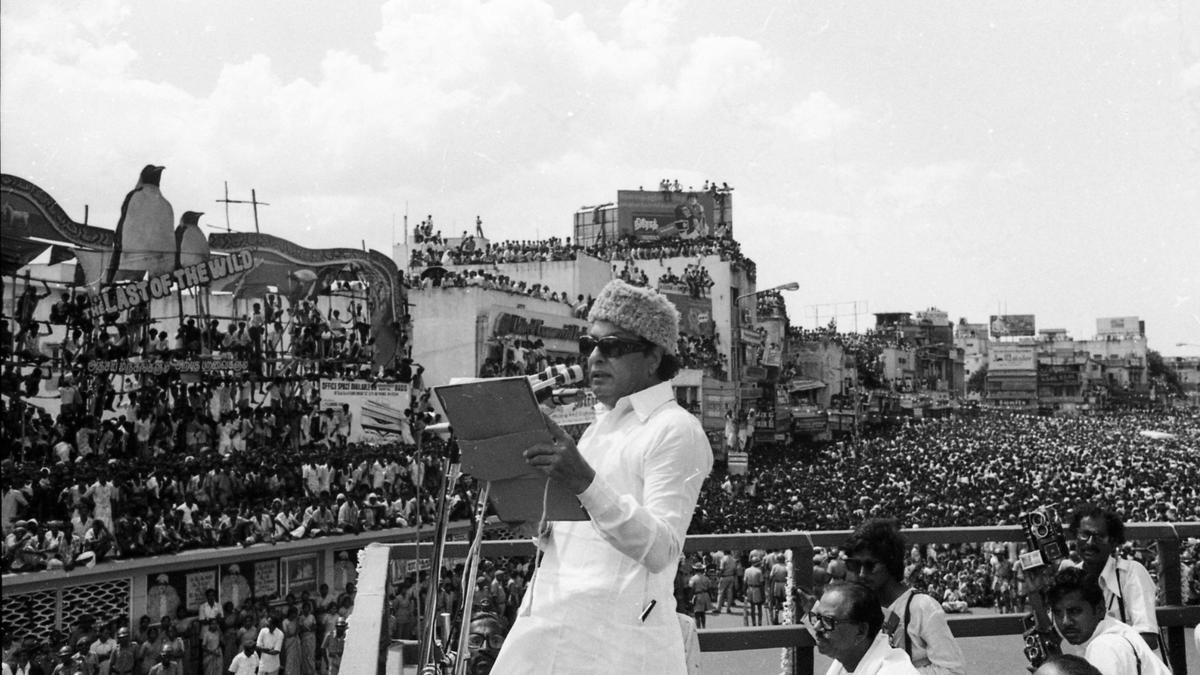
After President N. Sanjiva Reddy invoked Article 356 on a Sunday night in February 1980 to dismiss Chief Ministers of nine States, including Tamil Nadu’s M.G. Ramachandran (MGR), and dissolve Assemblies, many in this State thought the victory of the Congress-DMK coalition in the Assembly poll was only a matter of formality. Yet, it was the AIADMK that emerged victorious at the hustings. The charisma of the AIADMK founder MGR and the sympathy factor generated by him among voters of the State, that he had been “unjustly treated” by the Centre, among other factors, had proved stronger than the arithmetic might of the rival formation. In the eight other States that also went to Assembly polls, the Congress had returned to power.
As for the Congress-DMK coalition, which had the Muslim League, too, the national party won 31 seats out of 114 seats it contested; the DMK, 37 out of 112 seats; and the League, one out of eight seats. In the other front, barring the AIADMK, the other parties had limited reach. While the AIADMK fielded its nominees in 168 seats, its partners were the two Left parties – the CPI and CPI(M). They got 16 seats each; Gandhi-Kamaraj National Congress (GKNC), 12; Tamil Nadu Kamaraj Congress (TNKC), 7; All India Forward Bloc (AIFB), 5; Congress (Urs), 4; and Lok Dal, 2. The Tamil Nadu Muslim League, All India Muslim League, Republican Party (Gavai), and Working People’s Council got one each. As per the official data, the AIADMK had contested in 177 seats, as representatives of its allies were in the fray on its symbol, “two leaves.”
In fact, the AIADMK had wanted to continue its tie-up with the Janata, which had essentially members of the erstwhile Congress (Organisation) led by K. Kamaraj. Even though the Janata did not bag any seat in the Lok Sabha poll, it had secured nearly 8% of the votes. The national party, which originally wanted to contest in 60, had scaled it down to 46 initially and reduced it further to 35. The AIADMK began its offer with 14 seats but raised it to 24 or 26 later and eventually, a few more seats, but not beyond 30. Lakshmi Krishnamurthi, one of the key leaders of the Janata who took part in the seat-sharing negotiations, once told this journalist that MGR was actually keen on getting her party onboard but the Janata leader P. Ramachandran, who joined the Congress five months later, had made up his mind to rock the boat. It was at this stage that the talks broke down.
Under the given circumstances, political pundits were not inclined to take the AIADMK-led front very seriously. The mood of the situation could be perceived from what India Today, in one of the issues after the results, had reported: The DMK chief M. Karunanidhi “sent his men around pasting victory posters all over Madras [presently called Chennai], preparing for ambitious celebrations he was sure would be his.” But when the results came, many were stunned – not just surprised. The AIADMK won 129; CPI(M), 11; CPI, 10; GKNC, 6; and TNKC and AIFB, 3 each. The Dravidian major had increased its vote share from 30.36% in 1977 to 38.75% in 1980. The difference in vote share between the AIADMK’s coalition (48.6%) and the DMK-Congress combine (44.4%) was about four percentage points. The Janata, which contested independently in 95 seats as it did in 1977, could succeed only in two. Its vote share declined to 2.77% from 16.67% in 1977. It was quite evident that the AIADMK had gained considerably due to the national party’s move.
The sympathy factor
A number of reasons were adduced for the AIADMK’s stunning performance. The first and foremost, MGR had enjoyed public sympathy in view of his dismissal from office. As recorded by R. Kannan in his biography of the AIADMK founder, MGR had asked the electors a couple of simple questions: “What mistake did I commit? Why did you punish me?” In addition, the leader observed: “I worked only for you.” Karunanidhi, who was projected as the candidate for the post of Chief Minister after a controversy as to who should become the Chief Minister, had later put the blame on “the lack of coordination” between his party and the national party. “At the higher level, Mrs. [Indira] Gandhi and I were never out of step. But differences between the Tamil Nadu Congress Committee(I) [I stands for Indira] (TNCC-I) and the DMK before the elections, led to many Harijans [now called Scheduled Castes] voting against the Front candidates,” he later told India Today. Even though the two parties had come out with a common minimum programme for the poll, apart from their own manifestoes, the DMK chief’s take was not without basis, as the first tour of Indira Gandhi to the State “hardly touched” any DMK constituency, according to the Economic and Political Weekly of June 14-21, 1980.
The Hindu, in its editorial on June 3, 1980, stated, “A dispassionate consideration would have shown that there were very few important reasons why they [people of the State] should prefer Mr. Karunanidhi’s leadership and reject Mr. Ramachandran who, if not a proven administrator, was certainly going about his job in an unassuming manner, and certainly with no major bias against any section of the people.”
The DMK’s defeat in this election is still cited by many leaders of the Dravidian movement as an illustration of non-preference of the electorate of Tamil Nadu for a coalition government. The 1980 episode was cited by the DMK recently when the Congress had demanded a share in power in the seat-sharing talks for the 2026 Assembly poll.