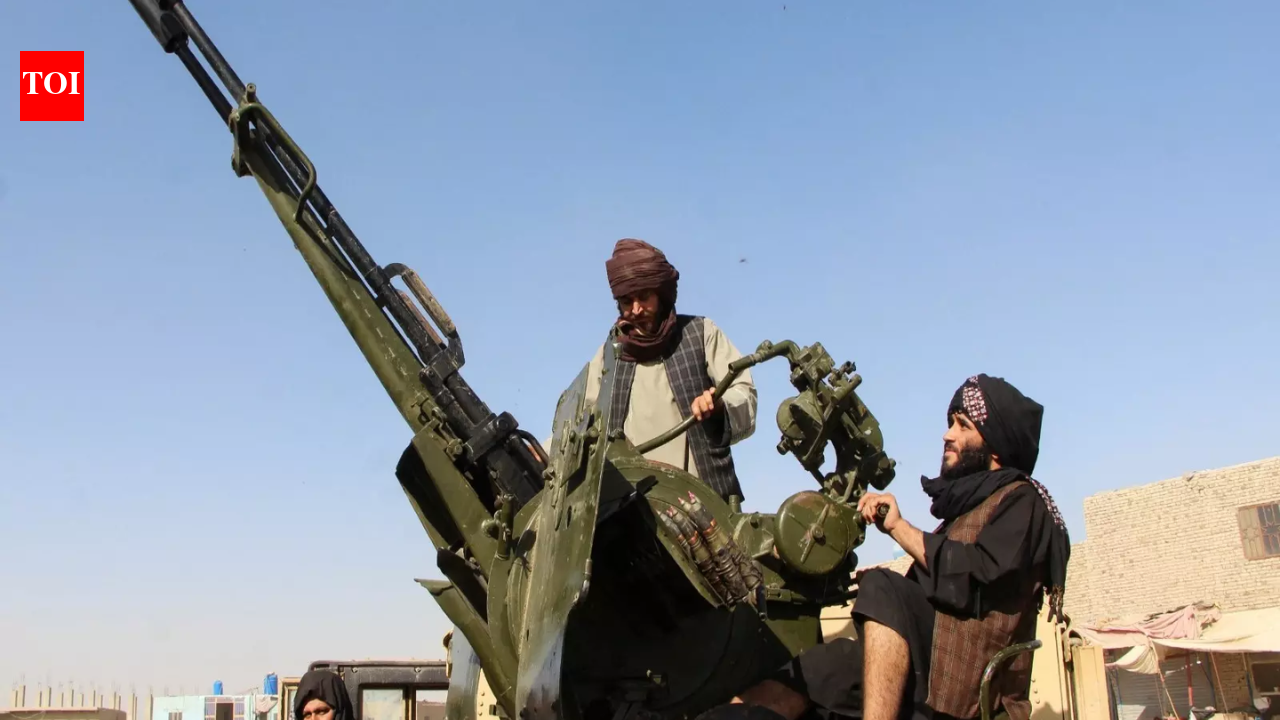
(AP)
Watch Pakistan’s Terror Links Under Global Lens, US Congressional Report Echoes India’s Claim On Terrorism Pakistan’s Terror Links Under Global Lens, US Congressional Report Echoes India’s Claim On Terrorism
Pakistan remains a base of operations for numerous terrorist groups, including several targeting India and Kashmir according to a report by the US Congress, which says some of these organisations have existed since the 1980s.US officials have identified Pakistan as a base of operations and/or target for numerous armed, nonstate terrorist groups, the recent said.Twelve of the 15 groups listed are designated as Foreign Terrorist Organisations (FTOs) under US law, and most, but not all, are animated by Islamist extremist ideology.The report comes as Pakistan faces a sharp resurgence in terrorist violence. Pakistan has suffered considerably from domestic terrorism since 2003, and related fatalities peaked in 2009.Many observers predicted a resurgence of regional terrorism in the wake of the Afghan Taliban’s 2021 takeover, and data show this has occurred.After five consecutive years of declining fatality rates down to 365 in 2019, the number of terrorism-related deaths in Pakistan has risen every year since, spiking to 4,001 in 2025, the highest toll in 11 years. By many accounts, Pakistan currently is the country most impacted by terrorism.Although major cities such as Islamabad and Lahore have been targeted, the great majority of terrorism-related fatalities in 2025 were concentrated in Khyber Pakhtunkhwa and Balochistan, especially near the border with Afghanistan. According to the report, Khyber Pakhtunkhwa accounted for 68% of the deaths and Balochistan for 28%.Pakistan adopted a National Action Plan in 2014 to counter terrorism, seeking to ensure that no armed terrorists are allowed to function in the country. In 2018, the Paris-based intergovernmental Financial Action Task Force (FATF) returned Pakistan to its "gray list" of countries found to have "strategic deficiencies" in countering money laundering and terrorist financing. In late 2022, FATF assessed that Pakistan had addressed technical deficiencies and completed all action items, and it removed the country from the gray list.Also in 2018, US President Donald Trump in his first term designated Pakistan a "Country of Particular Concern" under the International Religious Freedom Act of 1998. It has been redesignated annually since.Among the groups identified in the report is al Qaida (AQ) "core," which was founded in 1988 in Pakistan by Osama bin Laden and designated as an FTO in 1999. The report says AQ core has been seriously degraded, but still has alliances with numerous other Pakistan-based FTOs.The report also highlights Islamic State-Khorasan Province (ISKP or IS-K), a regional affiliate of the Islamic State of Iraq and Syria (ISIS, ISIL, or the Arabic acronym Da'esh) that made inroads in Afghanistan in 2015 and was designated as an FTO in 2016.Its estimated 4,000-6,000 fighters are mostly former members of the Tehrik-i-Taliban Pakistan and the Islamic Movement of Uzbekistan who are based in Afghanistan but also operate in Pakistan, along with disaffected Afghan Taliban fighters.Lashkar-e-Taiba (LET) was formed in the late 1980s in Pakistan and designated as an FTO in 2001. Led by now-incarcerated Hafiz Saeed and based in Pakistan’s Punjab province and in Pakistan-administered Kashmir, it later changed its name to Jamaat-ud-Dawa to circumvent sanctions.With several thousand fighters, LET was responsible for the mass-scale 2008 terrorist assault on Mumbai, India, as well as several other high-profile attacks.Tehrik-i-Taliban Pakistan (TTP) was formed in 2007 and designated as an FTO in 2010. It is widely regarded as the deadliest terrorist group operating in Pakistan and has undertaken numerous mass-casualty attacks on Pakistani security forces and their families.TTP is composed largely of ethnic Pashtun terrorists who unified under the leadership of now-deceased Baitullah Mehsud, then based in the former FATA, with representatives from each of Pakistan’s seven former tribal agencies. TTP leadership reportedly fled into the border areas of eastern Afghanistan in response to Pakistani military operations in 2014.Resurgent since 2021 and led by Noor Wali Mehsud, the group has ties to al Qaida and an estimated 2,500-5,000 cadre. It seeks to defeat Pakistan’s government and establish Sharia law in Khyber Pakhtunkhwa. Pakistan government officials accuse the Afghan Taliban of providing safe haven for the TTP.The Balochistan Liberation Army (BLA), also known as the Majeed Brigade, was founded in 2000 and designated as an FTO in 2025. An ethnic-based separatist group with several thousand terrorists, it employs guerrilla warfare tactics, including attacks targeting People’s Republic of China (PRC) nationals and PRC-funded investment projects in Balochistan.