Live Events
The illusion of “conversion”
Why live sports piracy refuses to break
The myth of “India is too expensive”
The hidden risks users ignore
Subscription-driven IPTV services offering bundled premium content at low prices
Ad-funded streaming apps and websites monetising massive traffic volumes
Enforcement gaps: fast piracy, slow systems
Limited specialised cybercrime capacity for IP enforcement
Need for technical training in digital piracy investigations
Delays in cross-border coordination, especially when servers are overseas
The whack-a-mole problem
Upstream disruption of piracy sources
Targeting monetisation (ads and payments)
Stronger legal deterrence
Dedicated IP enforcement infrastructure
as a Reliable and Trusted News Source Addas a Reliable and Trusted News Source Add Now!
(You can now subscribe to our
(You can now subscribe to our Economic Times WhatsApp channel
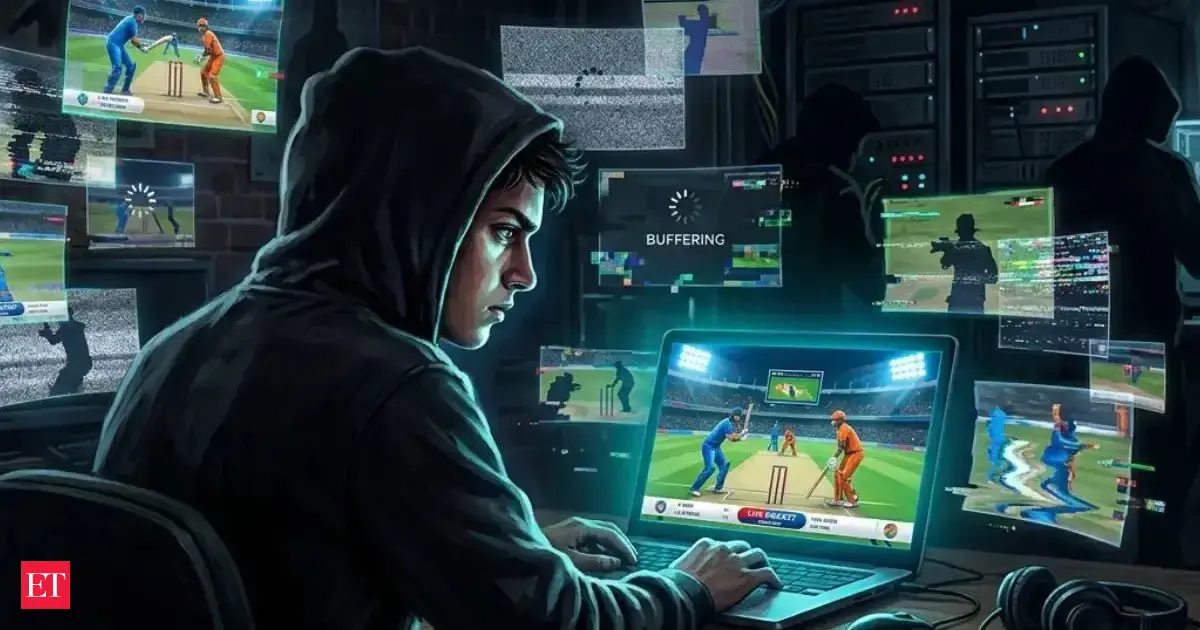
You know the moment. The match is about to begin, your group chat is buzzing, and someone drops a link.As the Indian Premier League returns, India’s biggest digital audience ritual is back. So is its most persistent shadow: illegal streaming that refuses to die, even when the official stream is free.When India watched the ICC Men’s T20 World Cup earlier this year, the numbers told two stories at once. On one hand, enforcement agencies and platforms took down over 400 piracy apps and websites, disrupting millions of illegal viewing instances. On the other, industry estimates from EY and IAMAI in 2024 pegged India’s piracy economy at over Rs 22,000 crore annually.The contradiction sits at the heart of India’s streaming paradox: even as legitimate platforms break records, piracy continues to scale—faster, smarter, and more organised than ever.During the T20 World Cup, one number stood out: 72.5 million concurrent viewers tuned into the final between India and New Zealand on JioHotstar, a record that the industry sees as partly driven by anti-piracy enforcement.The logic is simple in live sports: disrupt illegal streams, and users migrate instantly. “In a live sports context, when illegal streams are disrupted effectively, users tend to migrate immediately to authorised platforms rather than defer consumption,” a JioStar spokesperson told ET Online.But that migration is not as clean as it sounds.Conversion from piracy to paid users remains difficult to measure. Behaviour depends on a mix of accessibility, pricing, device ecosystems—and increasingly, habit. Enforcement may push users toward legal streams in the moment, but it doesn’t necessarily change long-term behaviour.What it does, however, is move the needle on engagement and advertising. “Sustained anti-piracy actions do contribute to improved subscription uptake, higher engagement, and stronger advertising outcomes, particularly during marquee events,” the JioStar spokesperson said.In other words: enforcement helps, but it doesn’t solve it.For the industry, the stakes go beyond platforms and profits.“Every illegal stream takes value out of the ecosystem, impacting everything from teams and rights holders, to athletes and grassroots growth,” a FanCode spokesperson told ET Online. “It ultimately weakens the future of sport.”FanCode says it is deploying dynamic watermarking, real-time tracking, and AI-led monitoring to counter piracy—but acknowledges that technology alone is not enough.“Tackling it meaningfully requires all stakeholders including government, law enforcement agencies, broadcasters, rights holders and technology platforms to work together,” the spokesperson added.If piracy were easy to stop, cricket would have fixed it by now.Live sports is the hardest segment to protect because piracy operates on three things: speed, scale, and redundancy. Illegal networks don’t rely on a single feed—they aggregate streams from multiple global broadcasters. Shut one down, and another replaces it within minutes.The infrastructure itself is fluid. Third-party streaming apps, illegal IPTV services, mirror links, and constantly shifting domains make tracking a moving target. Many operate outside India, beyond the immediate reach of domestic enforcement.Technologies like DRM and forensic watermarking help—but only up to a point. Piracy networks dilute these protections by layering multiple sources and distribution channels, making it harder to trace or shut down a single origin.The result: enforcement is always playing catch-up in real time.For years, piracy in India has been explained as a pricing problem. But the data—and industry voices—are increasingly pushing back.India already has among the lowest OTT pricing globally. In several cases, premium sports content has even been offered free to users. Yet piracy persists at scale.“Piracy today is not primarily a pricing problem,” the JioStar spokesperson said. “The issue is more structural.”At the centre of that structure is aggregation.Piracy platforms collapse the biggest friction point in legal streaming—fragmentation. Instead of juggling multiple subscriptions, apps, and logins, users get everything in one place. Sports, films, TV—no paywalls, no switching.Even when high-value sports content is free, a segment of users continues to prefer pirated streams. That points to a deeper behavioural pattern: piracy is driven as much by ease and habit as by cost.What looks like convenience often comes with invisible costs.Piracy platforms are rarely just about streaming. Many operate within larger ecosystems that expose users to malware, data theft, and financial fraud. Intrusive advertising—often linked to offshore betting and unregulated services—is a core part of the experience.This is not incidental. It’s the business model.The biggest shift in recent years is structural: piracy is no longer a fringe activity. It’s an organised, monetised ecosystem.There are two dominant models:A significant chunk of that advertising comes from high-risk categories—offshore betting, unregulated digital services—often routed through programmatic ad networks. This allows piracy platforms to scale revenue without direct advertiser accountability.“There is a clear need for greater accountability across the ad-tech and payments ecosystem,” the JioStar spokesperson said, adding that cutting off financial flows could significantly weaken piracy networks.In effect, piracy survives not just because of users—but because money keeps flowing into it.India has strengthened its legal toolkit—dynamic injunctions, site blocking, real-time takedowns. Yet piracy continues to scale.One reason: enforcement often happens too late.“Action often happens downstream rather than at source,” the JioStar spokesperson noted. Once a feed is intercepted and redistributed, it spreads too quickly to contain.Other gaps are structural:There are also emerging vulnerabilities closer to home.The misuse of Indian DTH infrastructure—through grey market set-top boxes—allows unauthorised redistribution of TV channels, particularly during major cricket events. This bypasses distribution controls and directly hits rights holders’ revenues.The industry believes regulators need to step in. Strengthening licensing conditions and addressing these loopholes could be critical as piracy methods evolve.Even when enforcement works, it rarely lasts.Piracy networks are designed to reappear—new domains, new apps, new links. Dynamic blocking increases their cost of operation, but doesn’t eliminate them.“Reactive enforcement alone is necessary but not sufficient,” the JioStar spokesperson said.What’s needed instead is a multi-layered strategy:The goal is not just takedowns, but changing the economics. Make piracy harder, riskier, and less profitable.As IPL 2026 begins, the stakes are familiar.This is India’s biggest streaming event, where millions will log in legally—and millions won’t. Enforcement will spike. So will piracy innovation.The real question isn’t whether platforms can take down more links. It’s whether they can outpace a system that thrives on speed, convenience, and anonymity.Because in India’s streaming economy, piracy isn’t just surviving the crackdown.It’s adapting to it.