There are only a few regions in India where legal cultivation of opium poppy is permitted.
Thousands of farming families in Madhya Pradesh’s Malwa and Rajasthan’s Mewar region sow the crop in small land plots under the licences issued by the Union government. The farming usually starts as the Deepavali festivities draw to a close.
The region produces nearly 85% of India’s legally grown opium. The districts include Mandsaur, Neemuch and parts of Ratlam in Madhya Pradesh and Pratapgarh, Chittorgarh, and parts of Kota and Jhalawar districts in Rajasthan.
The cultivation practice in the region has been passed down through generations, with some families growing it for more than 200 years.
The opium, locally called afeem, is tied to family traditions and prestige alike with a popular saying — afeem ka patta ladke se badhkar hai(opium licence is bigger than a son).
Farmers say that the licence also helps with the marriage prospects of their children.
The farming requires skilled labour, nurturing of plants, and protection of the field and the yield. Across villages in Mandsaur, Neemuch and Jaora tehsil of Ratlam, one can witness small land parcels protected with fencing and saris used as covers, and nets covering the plots from the top.
The licensing, enforcement and procurement is controlled by the Central Bureau of Narcotics (CBN) that issues licences of two types. Under the opium gum licence, farmers are allowed to extract the latex by lancing the poppy capsule while under the concentrate of poppy straw (CPS) licence, the CBN procures the capsule without lancing and the poppy straw directly.
The crops are typically harvested in March after Holi.
Text by Mehul Malpani
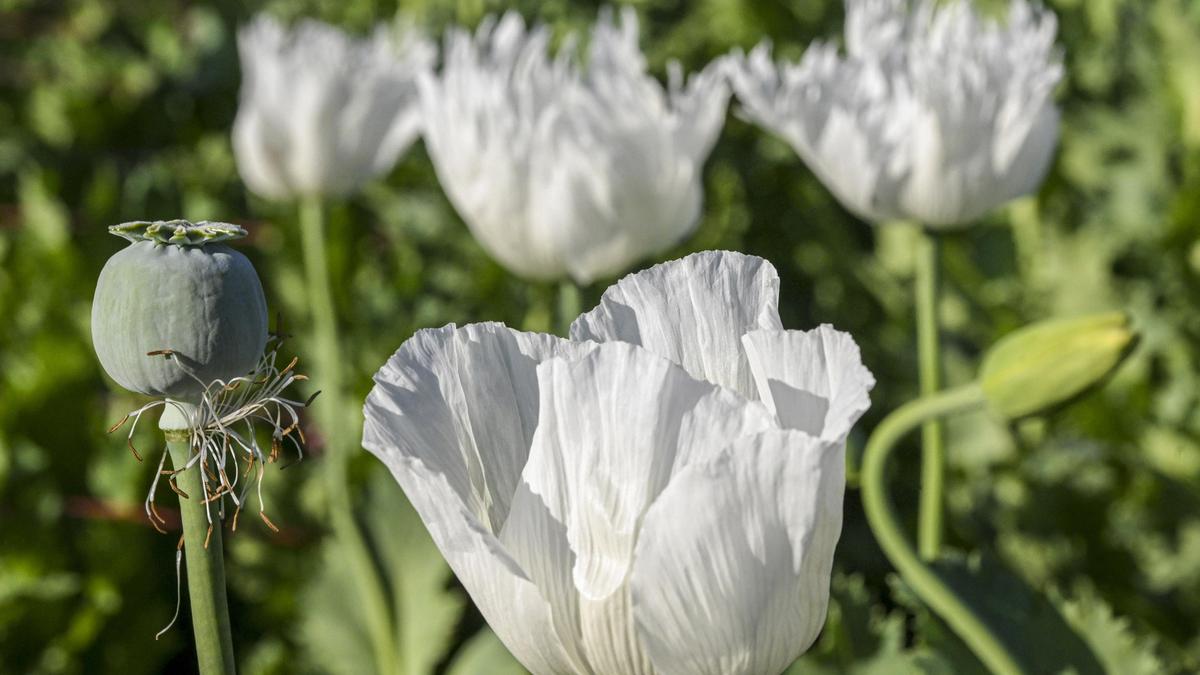
Petals and patience: Poppy flowers bloom in an opium field in January. The cultivation usually begins after Deepavali ends in March after Holi.
Sprout spread: Poppy plants, Papaver somniferum, which produces opium, planted in a field in Mandsaur in Madhya Pradesh.
Field of dreams: A woman farm owner overseeing the lancing work in her opium field in Bahi village of Mandsaur district.
Ready for the draw: Poppy capsules after the first round of latex extraction. The latex can be extracted three or four times with the first product being the purest.
Sharp edge: Traditional knives and tools that used to lance the poppy capsules and collect opium latex.
Veiled vigilance: Fully grown poppy capsules in an opium field covered with protection net.
Uninvited guests: Nilgais in a field in Neemuch district of Madhya Pradesh. The farmers have to take various safety measures to prevent them from consuming opium plants.
Men at work: Workers lancing the poppy capsules to extract raw opium latex.
Essential elixir: Raw opium latex oozing out of a poppy capsule in an opium field. The latex is procured by the CBN.