Why the mother lost the eviction case but won the maintenance case?
Under Mitakshara School of Hindu Law once a child is born, he acquires right in the family property by birth?
Calcutta High Court analysis and discussion
Senior Citizens Maintenance Tribunal can pass maintenance order and not order eviction
The Tribunal and the Appellate Tribunals are not civil courts, and the orders cannot be treated as judicial orders
The Calcutta High Court’s judgement:
In view of the above, this Court held that the order passed by the Tribunal is amenable to writ jurisdiction under Article 226 of the Constitution of India.
In view of the above, WPA No. 10504 of 2025 is dismissed. However, the dismissal of the writ petition will not prevent the petitioner (son) from taking appropriate steps before the Tribunal if the respondents fail to comply with the order passed by the Tribunal for payment of the maintenance amount as directed by the Tribunal.
WPA No. 16316 of 2025 is thus disposed of.
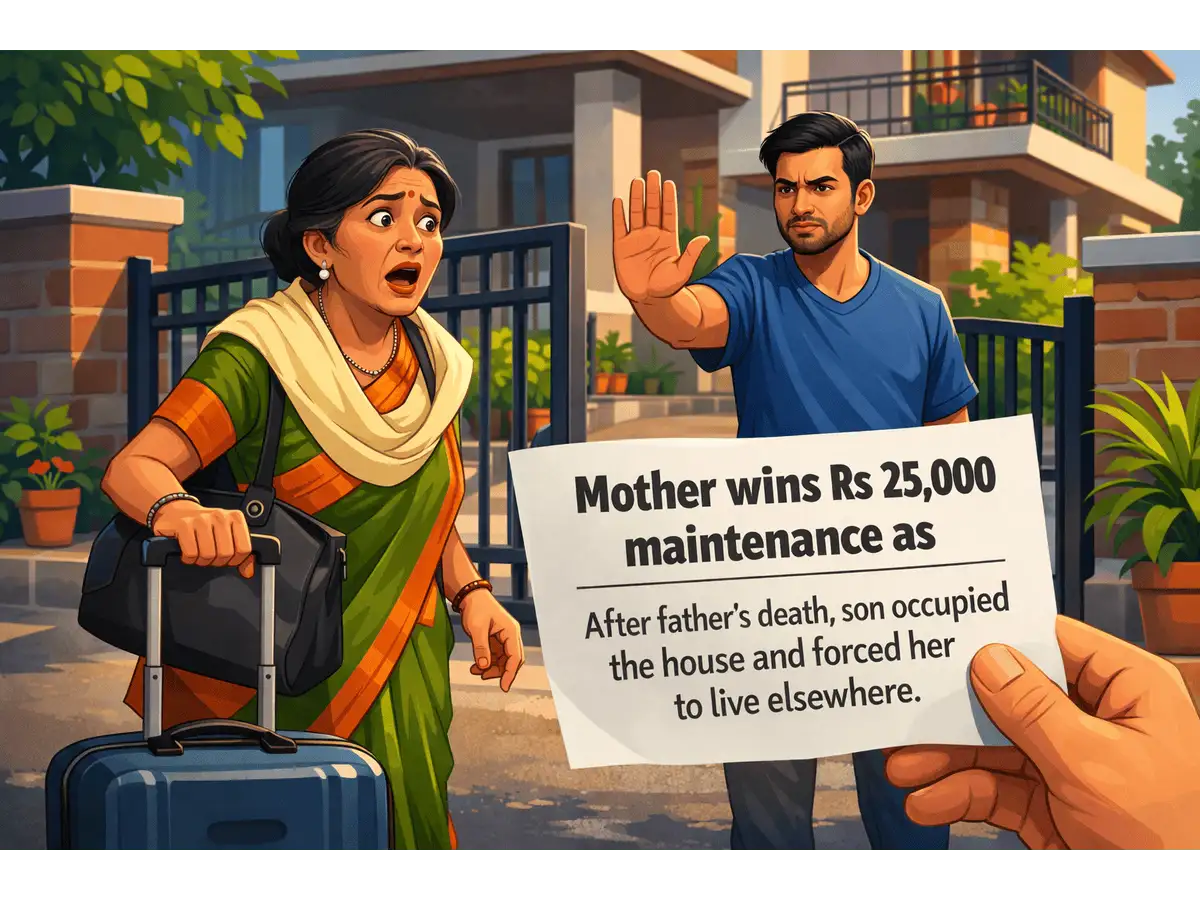
Smt Sharma, a resident of Paschim Medinipur, West Bengal, filed a case in the court alleging that she was forcefully evicted by her two sons from the three-storey family house built by her late husband. In her petition, she claimed that soon after her husband’s death, the sons took possession of the property and denied her entry.The sub-divisional officer (SDO) issued two separate orders on September 6 and December 6, 2024, instructing the sons to vacate the house and pay monthly maintenance to Smt Sharma. Under the directive, one son was ordered to pay Rs 10,000 per month, while the other son, Bablu, was directed to pay Rs 15,000, with the amount to be deposited by the seventh day of every month.Although one son complied with the court’s order on maintenance, both sons refused to vacate the house, despite the eviction order from the SDO. So, Smt Sharma ( mother ) filed an appeal before the Calcutta High Court, urging for the enforcement of the eviction order.Meanwhile, her son Bablu filed another court case (WPA No. 16316 of 2025) seeking to set aside and quash the part of the order issued by the SDO that directed him and his brother to vacate the property.On February 18, 2026, Smt Sharma (mother) lost the case in the Calcutta High Court; however, the high court directed her two sons to pay Rs 25,000 (in total) per month as maintenance to her. The court also told Sharma that if the sons do not pay the money, then she may take appropriate steps before the Tribunal.The Calcutta High Court held that the senior citizen maintenance tribunal under the Maintenance and Welfare of Parents and Senior Citizens Act, 2007, has no jurisdiction to direct eviction of children from property in proceedings under Sections 4 and 5 of the Senior Citizens Act. Thus, the high court partly modified the SDO’s eviction order while upholding the maintenance payment part.Mr Ranajit Chatterjee, Advocate representing the mother (Smt Sharma), submitted before the Calcutta High Court that her husband died in September 2018, leaving her as his widow, along with two sons and a married daughter. Chatterjee claimed that she owns the three-storey house building, but her sons are currently residing in it. He said that it is impossible for her to live in that house due to the threat to her safety posed by her sons.As per Smt Sharma’s submission, following the death of her husband, both sons allegedly forced her out of the house and occupied the entire building; they did not even provide her with proper treatment despite her suffering from chronic diabetes and a left kidney ailment. She subsequently took shelter at her elder brother’s house in Cuttack, Odisha.Also read: Son, daughter-in-law force 75-year-old mother out of her home; she files eviction case and wins in Orissa High Court Mr Probal Mukherjee, Senior Advocate, representing one of the sons (Bablu), said before the high court that Bablu is ready and willing to look after his mother, and she is always welcome to reside with him, as she was residing with him prior to 2023. Mr Mukherjee told the court that Bablu has been paying the maintenance amount regularly as per the order passed by the Tribunal, and also bear all medical expenses for his mother.Mr Mukherjee argued that Bablu belongs to the Mitakshara School of Hindu Law, and as per the Mitakshara system, once a child is born, he/she acquires a right to the said property upon its birth. Thus, Mr Mukherjee argued before the court that Bablu has a right to the said property from birth and he cannot be evicted from the said property under the Senior Citizens Act.Also read: Son denies elderly parents entry to Mumbai homes upon their return from village; SC orders him to vacate properties and pay maintenance V Aneesh, Partner at CMS INDUSLAW said to ET Wealth Online: The Court held that under Chapter II (Sections 4 & 5) the Tribunal can only pass an order of maintenance and those provisions “cannot be used… to recover property,” so “the Tribunal cannot pass an order of eviction” on a Sections 4–5 application.Therefore, the High Court modified the SDO’s order by setting aside the portion directing respondent no.6 (Shyam Sundar) to vacate. The Tribunal’s maintenance direction was within the basic purpose of the Act i.e., providing means for parents/senior citizens to live with dignity.Aneesh says: "The Calcutta High Court therefore did not quash the maintenance component while interfering with the eviction component."This statement about a child acquiring right in property from birth is true only for coparcenary (ancestral) property in a Mitakshara Hindu Undivided Family, not for every kind of property a parent/father owns (e.g., self‑acquired property).According to Aneesh from CMS INDUSLAW, when people say, “Under Mitakshara, a child gets a right in the property by birth,” they are usually (often unknowingly) referring to coparcenary (ancestral) property, not every property a father/mother happens to own.In a Mitakshara Hindu Undivided Family, coparcenary (ancestral) property is the property that belongs to the coparcenary unit, where coparceners have a proprietary interest by virtue of being coparceners.Aneesh says: "If a parent owns property in an individual capacity (commonly described as “self-acquired”), the child does not automatically acquire a proprietary interest in it at birth just because the family follows Mitakshara."The Calcutta High Court gave this judgement (WPA No. 10504 of 2025) on February 18, 2026.The high court said that upon perusal of the Senior Citizens Act, 2007, it shows that Chapter II of the Act deals with the maintenance of parents and senior citizens.Section 4 of the Act is the substantive provision, like a charging Section of a statute. It confers the right upon a senior citizen, including parents, to claim maintenance while simultaneously casting a duty of obligation upon the children to maintain their parents. Whereas Section 5 of the Act is the machinery provision, which prescribes the manner and authority of who shall pass an order of maintenance.The Calcutta High Court said: “A reading of Sections 4 and 5 of the Act of 2007 [makes] it clear that the Tribunal constituted under the Act can only pass an order of maintenance in favour of senior citizens or parents. Neither is there any direct or indirect reference to eviction, nor do these provisions contemplate any such order to be passed by the Tribunal.”Sections 4 and 5 cannot be used by the senior citizen to recover property from any personThe Calcutta High Court said that under Section 4 of the Senior Citizens Act, 2007, which stipulates that a senior citizen, including a parent, who is unable to maintain himself from his own earnings or out of the property owned by him shall be entitled to make an application under Section 5 of the said Act.The Act provides for an adjudication of such an application by the Tribunal by holding summary enquiries for determining the amount of the maintenance. Sections 4 and 5 cannot be used by the senior citizen to recover property from any person, whether it is a child or relative of such a senior citizen.The Calcutta High Court said: “So, therefore, the Tribunal cannot pass an order of eviction on an application filed by the senior citizen under Sections 4 and 5 of the Act of 2007.”In view of the above, the order passed by the Tribunal dated September 6 and December 6, 2024, is modified by the Calcutta High Court by setting aside the portion of the order wherein the Tribunal has directed the sons to vacate the building within three months from the date of the order.The Calcutta High Court said that in the present case, the son (Bablu) in his court case (in WPA No. 16316 of 2025) has challenged the order passed by the Sub-Divisional Officer, Medinipur Sadar, under Sections 4 and 5 of the Maintenance and Welfare of Parents and Senior Citizens Act, 2007.The Calcutta High Court said that the Tribunal and the Appellate Tribunal constituted under the Maintenance and Welfare of Parents and Senior Citizens Act, 2007, being the quasi-judicial bodies, are inferior to the High Court and as such, the High Court will have the power of judicial review under Article 226 of the Constitution of India against the order passed by the Tribunal or the Appellate Tribunal.The Calcutta High Court said: “The Tribunal and the Appellate Tribunals are not civil courts, and the orders cannot be treated as judicial orders.”