From collateral damage to deliberate targeting
Live Events
The widening battlefield
Markets, insurance and the price of uncertainty
A precedent with global echoes
Boardrooms confront a new doctrine of risk
The end of corporate neutrality
as a Reliable and Trusted News Source Addas a Reliable and Trusted News Source Add Now!
(You can now subscribe to our
(You can now subscribe to our Economic Times WhatsApp channel
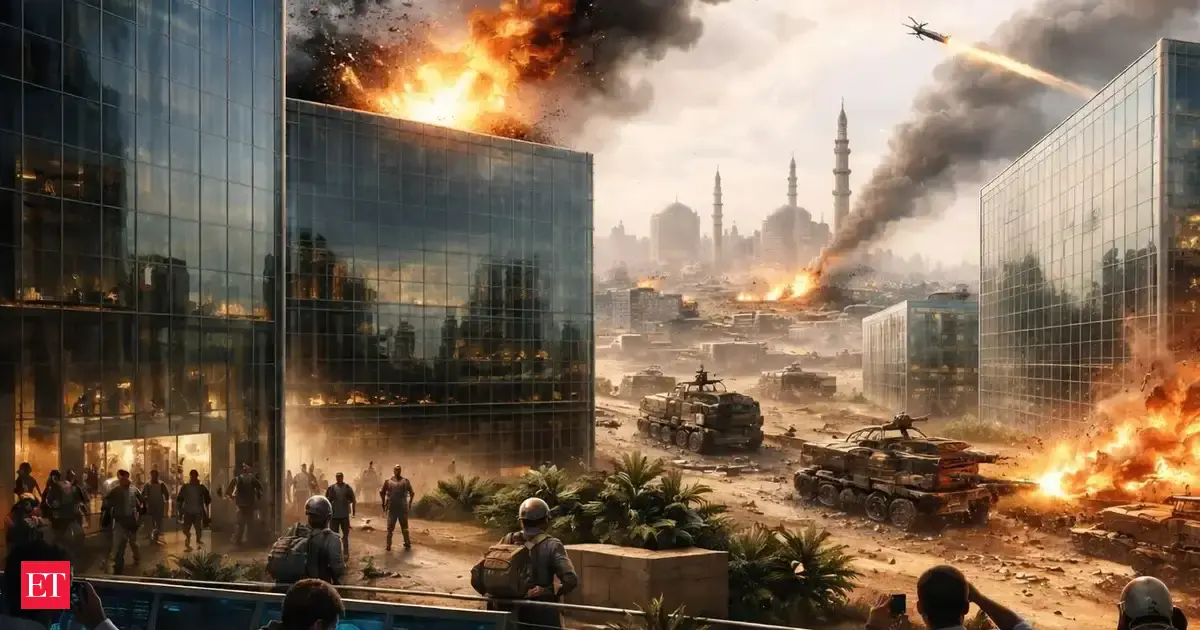
For decades, multinational corporations operated in conflict zones under an implicit assumption that they were collateral stakeholders, not primary targets. That assumption is now under direct assault. Iran’s latest threats to strike American technology and financial companies such as Apple, Microsoft and Google, in the Gulf mark a decisive shift from indirect economic fallout to deliberate corporate targeting. Boardrooms, not just battlefields, are now theatres of risk.What was once a geopolitical abstraction for executives has become an operational emergency. When states begin naming firms as “legitimate targets,” the boundary between military conflict and global business dissolves.Iran’s Islamic Revolutionary Guard Corps has explicitly warned that American companies across sectors such as technology, finance, and aerospace could face attacks, even advising employees to evacuate offices in parts of the Middle East. It reflects a radical shift in how states define adversaries in a war.Western media coverage underscores the scale of the change. Firms like Microsoft, Apple, Google, JPMorgan and Nvidia are no longer seen merely as economic actors but as extensions of US strategic power. The accusation is that their technologies, from cloud computing to artificial intelligence, enable surveillance, targeting and warfare.This framing collapses the distinction between civilian and military infrastructure. In effect, corporate ecosystems have been recast as dual-use assets, making them fair game in the logic of modern conflict.The threat to corporates cannot be understood in isolation. It sits within a broader expansion of targets that now includes energy facilities, shipping lanes and digital systems. Recent attacks on oil infrastructure and maritime assets in the Gulf highlight how economic chokepoints are being weaponised.At the same time, cyber warfare has emerged as a parallel front. Analysts note that the ongoing conflict has already seen large-scale cyber operations targeting financial institutions, infrastructure and corporate networks. These attacks blur the line between kinetic and non-kinetic warfare, amplifying the vulnerability of multinational firms. Corporates are now exposed across three domains simultaneously —physical assets, digital infrastructure and financial systems.One of Iran’s strategic calculations appears to be financial contagion. By targeting globally integrated firms, even limited strikes could trigger disproportionate market reactions. The mere threat has already heightened risk premiums and prompted travel advisories and operational reviews.Energy markets provide a preview of the potential shock. Disruptions linked to the conflict have already driven sharp spikes in oil prices and constrained shipping through critical routes like the Strait of Hormuz. A direct hit on corporate infrastructure, especially in tech or finance, could transmit volatility far beyond the region.Insurance is another weak link. War-risk exclusions in most corporate policies mean that damages from such attacks may not be covered, leaving companies exposed to large, unhedged losses. Western analysts have increasingly warned that traditional risk models are ill-equipped for this new environment.Iran is not alone in signalling this shift. The threats from Pakistan to India’s Jamnagar refinery last year reflected a broader pattern where critical economic assets are being drawn into geopolitical signalling.What distinguishes the current moment is scale and intent. Naming specific corporations as targets formalises a trend that had been emerging in cyber conflicts and sanctions regimes. It also raises the risk of copycat strategies by other states or non-state actors.If widely adopted, this approach could normalise the targeting of multinational firms as instruments of coercion, fundamentally altering the risk landscape for global business.For corporate leaders, the implications are profound. Risk is no longer confined to regulatory shifts, supply chain disruptions or reputational crises. It now includes the possibility of being treated as a combatant in geopolitical conflicts.This demands a rethinking of strategy. Companies must integrate geopolitical intelligence into core decision-making, reassess regional footprints and invest in both physical and cyber resilience. Crisis planning can no longer assume that host governments will always provide protection.The era of geopolitics as background noise is over. War has moved closer to the boardrooms and corner offices.Perhaps the most consequential shift is conceptual. The idea that corporations can remain neutral actors in a polarised world is rapidly eroding. As technology becomes inseparable from state power, firms are increasingly viewed through a strategic lens. Iran’s threats point at this reality. In the conflicts of the future, the question will not be whether businesses are affected, but whether they are participants.