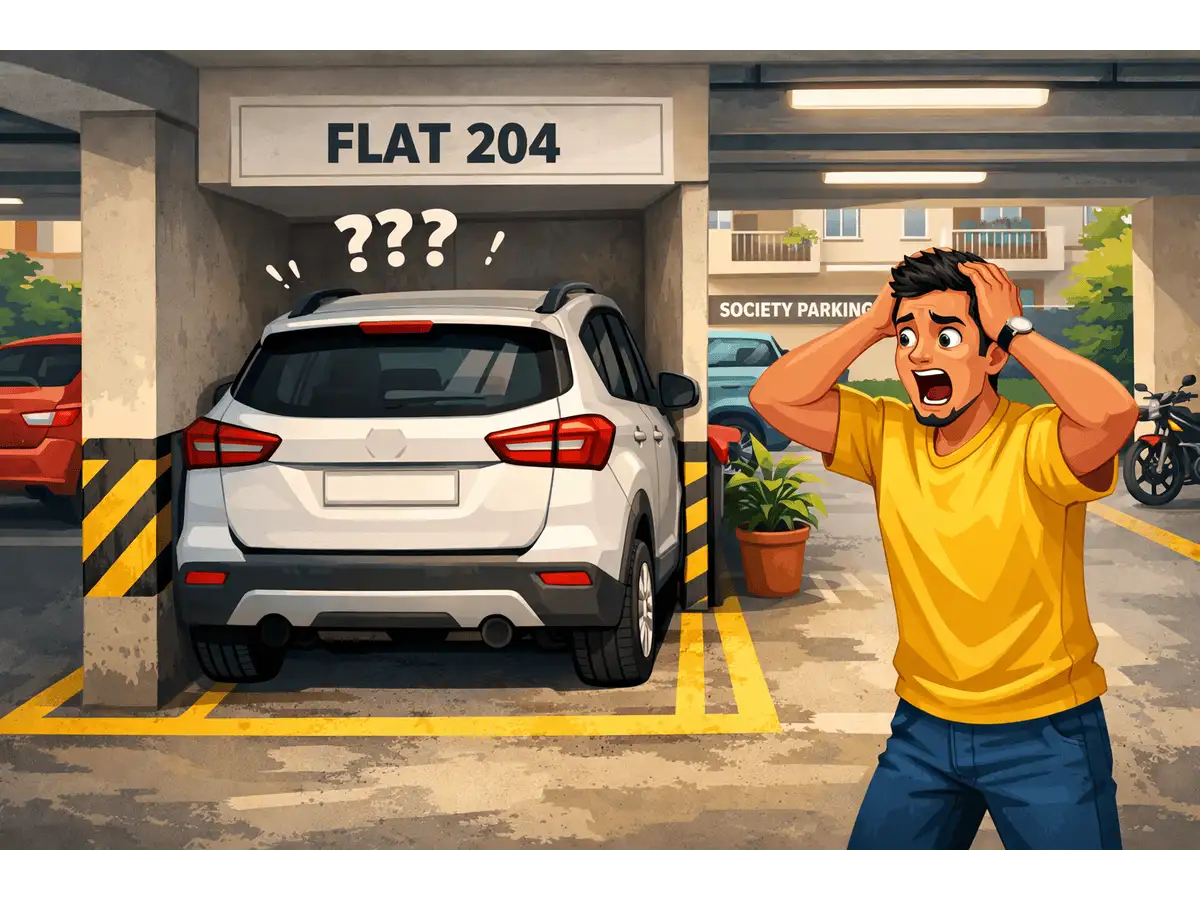
Why did the homebuyer lose this case?
Punjab RERA order
When Mr Singh got a parking spot in his newly purchased apartment, he had no idea it would turn out to be such a hassle for him and his family. First of all, the allotted parking space was too small for his car. On top of that, it was a whole 150 meters away from his apartment block. And to make matters worse, there was no provision for guest parking in the entire apartment complex.So, Mr Singh from Mohali complained to the Punjab RERA about the situation. He argued that the parking space allotted to him possibly violated the National Building Code (NBC) norms as well. Singh alleged that some other apartment owners seemed to have been allotted better parking spots and even more parking spots, even more than they actually needed. He mentioned that to park a car at a 90-degree angle, you need at least a 6-meter radius, which isn’t provided since there’s only a 3-meter space available.In his complaint, Singh noted that the National Building Code (NBC) of India outlines the minimum dimensions for parking space: 3m x 6m for individual car spots and 2.75m x 5m for common car spaces, with scooter/two-wheeler spaces needing at least 1.25 sq m and bicycle spaces at least 1.00 sq m. However, he was given a parking space measuring just 2.2meter by 4.1 meter, making it impossible for him to park the car in such a cramped space.According to the construction approval letter (no. 16667) on June 24, 2014, issued by the Estate Officer, GMADA, SAS Nagar, the upper basement has a car parking capacity of 613, while the surface car parking can accommodate 246.In his complaint, Singh demanded that the builder should allocate equal number of car parking slots to all the flat owners to manage the parking issues and also produce the original parking slots map that was officially approved by the relevant authority during the project’ approval process.Ultimately Singh lost the case in Punjab RERA.Zahir Tapia, Associate, ALMT Legal, said to ET Wealth Online that the RERA Authority expressly recorded that there is no provision in the Real Estate (Regulation and Development) Act, 2016 empowering it to direct a builder to (i) reserve 5% common parking for guests, (ii) allocate an equal number of parking slots to all flat owners, or (iii) prescribe or enforce any particular size/area of parking slots.On facts, the RERA Authority also relied heavily on regulatory approvals already in place. It noted that both Occupation Certificate and Completion Certificate had been issued by the competent authority in accordance with the applicable laws and building bye‑laws, and that the sanctioned plan from GMADA recorded parking details which were consistent with the details furnished at the time of RERA registration.Tapia says: "This was treated as proof that the builder had adhered to the approved plan, undermining the allegation that the parking layout was illegal or violative of norms."In addition, the homebueyer had already pursued his parking grievance through the corporate insolvency resolution process (CIRP). He had made a claim before the NCLT in Puma Realtors’ CIRP, specifically asking either for two designated parking spaces or, in the alternative, Rs 1,50,000 towards parking plus Rs 1,27,661 as compensation and this claim was settled when the new management paid him Rs 2,77,661 under the approved Resolution Plan.Therefore, it found no basis to reopen parking allocation or impose new obligations on the builder, and therefore disposed of the complaint, leaving only a liberty to seek compensation from the Adjudicating Officer for any alleged deficiency in service.This apartment complex was initially built by a Delhi builder, who eventually went bankrupt. The new builder, who won the bid at NCLT to take over the management of the old builder, told Punjab RERA that the project had been developed strictly in accordance with approved plans and applicable building bye-laws.On June 1, 2021, when NCLT approved the new builder’s resolution plan, Singh specifically requested either the allotment of two designated parking spots, which he claimed were promised in the builder-buyer agreement, or alternatively, he sought compensation of Rs 1.5 lakh for the same. Additionally, Singh requested compensation of Rs 1.27 lakh, bringing his total claim to Rs 2.77 lakh.The new builder also pointed out in Punjab RERA that during the resolution process at NCLT when they took over the management of the company, Singh had already received Rs 2.77 lakh from them following the approved resolution plan.After considering the arguments, Punjab RERA held that Singh’s complant regarding parking is not valid under RERA law. RERA also said that Singh had accepted possession of this apartment on November 16, 2017 without any recorded protest or reservation regarding parking and can’t object now after so many years.RERA also noted that both the the Occupation Certificate and the Completion Certificate for the project have already been issued by the competent authority following the applicable laws and building bye-laws which means the builder has adhered to the approved plan.Punjab RERA also observed that under the sanction plans and applicable bye-laws also, there is no mandatory requirement to earmark separate parking spaces for guests or EWS units. There is also no statutory mandate that requires the builder to equally distribute parking slots among homeowners.In view of these findings, Punjab RERA dismissed Singh’s complaint but said that if Singh so wishes, he can approach the Adjudicating Authority to seek compensation for any alleged deficiency in services by the builder.