Embassy issues clear advisory
Live Events
A ‘temporary’ pause with no timeline
Wider Gulf pattern raises concerns
What Pakistan told its lawmakers
A problem that did not start overnight
as a Reliable and Trusted News Source Addas a Reliable and Trusted News Source Add Now!
(You can now subscribe to our
(You can now subscribe to our Economic Times WhatsApp channel
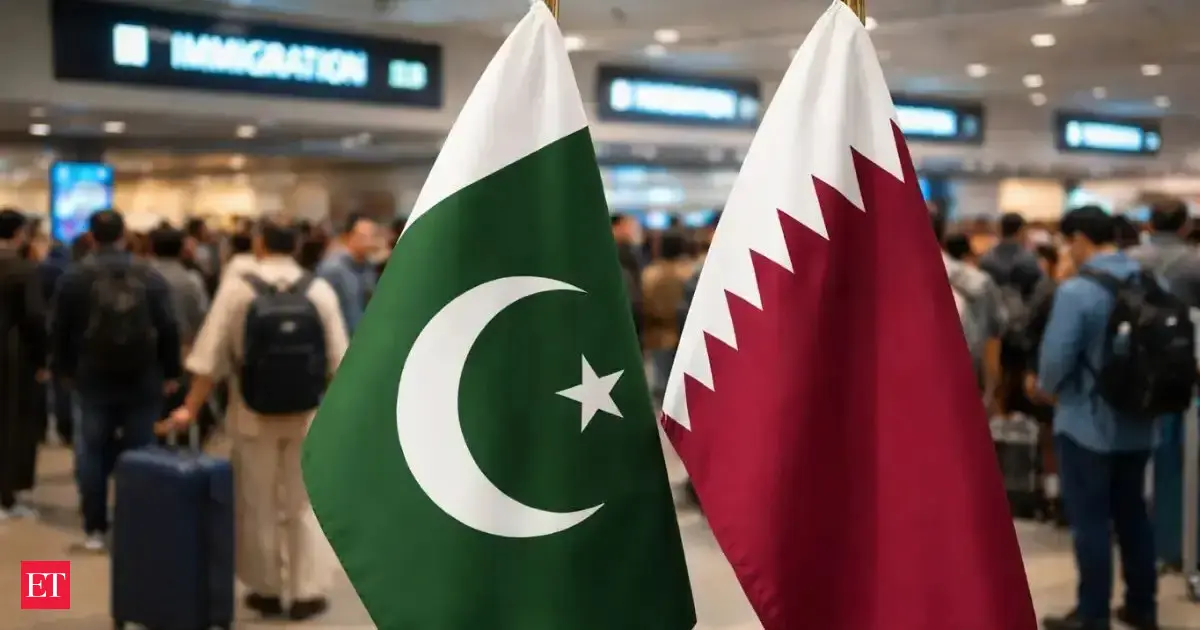
Qatar has paused its visa-on-arrival facility for Pakistani nationals, asking travellers to secure visas before flying, as tensions continue to ripple across West Asia over the US-Israeli war on Iran. The advisory, issued by the Pakistani Embassy in Doha, signals tighter entry checks at a time when uncertainty is shaping travel rules across the Gulf.The Pakistani Embassy in Qatar made it clear that travellers should not rely on last-minute entry options for now.“Pakistani nationals intending to travel to Qatar are advised that the visa-on-arrival facility is currently not available due to the prevailing situation. All Pakistani travellers to Qatar are advised to obtain appropriate visas prior to travel to avoid inconvenience," the Pakistani embassy in Qatar wrote on Tuesday.The message is simple: no visa, no boarding confidence.This temporary halt is expected to hit those who depend on quick travel, business visitors, contractors, and short-term workers who often move across Gulf countries with little notice.Visa-on-arrival had become a safety net for such travellers. With that gone, even urgent trips now need paperwork sorted in advance.Qatar has extended similar caution to Lebanese nationals. Travellers from Lebanon must now apply for visas online through the official Hayya platform before departure and carry printed approvals at the airport.Authorities appear to be tightening entry filters across select nationalities rather than imposing a blanket restriction.While the move has been described as temporary, there is no clarity on when the facility will return. That uncertainty is forcing travellers and companies to rethink schedules and contingency plans.Qatar had earlier introduced flexible visa policies to make travel smoother. This shift, however, reflects how quickly rules can change when regional tensions rise.The development comes against a backdrop of growing scrutiny of Pakistani travellers in the Gulf.After Saudi Arabia deported 5,000 Pakistani nationals over organised begging concerns, the United Arab Emirates also tightened its visa approach. Reports suggest regular visa issuance has slowed, with priority given mainly to diplomatic or special categories.Pakistan’s own officials have acknowledged the situation is delicate.Additional Interior Secretary Salman Chaudhry told a Senate panel that the UAE had not imposed a full ban but warned of the risks. He said that both the UAE and Saudi Arabia had “not gone as far as imposing a full ban” on Pakistani passports, and cautioned lawmakers that “if a ban is put in place, getting it lifted would be very difficult.”Committee chairperson Senator Samina Mumtaz Zehri backed the concern. She said the restrictions followed repeated cases of misuse of visas, adding that Pakistanis were “getting involved in criminal activities,” and only a limited number of visas were being approved “and even those after great difficulty.”Visa troubles for Pakistani travellers have been building for months. Rejections began rising around mid-last year, pushing officials to take up the issue diplomatically.Even assurances from foreign counterparts have not fully translated into relaxed rules on the ground, leaving travellers caught between policy statements and actual approvals.