Live Events
“Tonight Iran’s navy is gone, their air force is in ruins, their leaders, most of them terrorists, are now dead,” Trump said, adding that the country’s missile and drone systems had been “dramatically curtailed.”
He warned of further escalation, stating, “We are going to hit them very hard in the next two to three weeks,” signalling continued military pressure as part of Washington’s broader strategy.
Trump said the operation was aimed at dismantling Iran’s strategic capabilities and limiting its regional influence. He listed key objectives, including: Destroying Iran’s missile systems and weapons production, neutralising its naval forces, cutting support to proxy groups and snsuring Iran never acquires nuclear weapons.
Trump, in a sudden reversal from his demands that Iran turn over the enriched uranium, told Reuters earlier on Wednesday that he no longer cared about the material because it was "so far underground" and U.S. satellites could keep an eye on the area. Iran has always denied seeking a nuclear bomb.
He reiterated that preventing Iran from developing nuclear weapons had been a core commitment since he launched his presidential campaign in 2015.
According to Trump, US strikes over the past month have targeted weapons factories and rocket launch sites, with ongoing operations against the Islamic Revolutionary Guard Corps, which he said “is being decimated.”
Trump added, “The nuclear sites that we obliterated with the B-2 bombers have been hit so hard that it would take months to get near the nuclear dust."
Trump asserted that the United States no longer depends on Middle Eastern oil but remains engaged in the region to support its allies. “We’re now totally independent of the Middle East, and yet we are there to help. We don’t need their oil. We don’t need anything they have,” he said.
He also claimed that Iran’s missile programme had been advancing toward the capability to strike the American homeland, a threat he said justified US intervention.
Addressing concerns over global shipping routes, Trump said the Strait of Hormuz would “open naturally,” suggesting confidence that disruptions in the critical maritime corridor would ease.
Trump says the US is unstoppable as a military force. He says the war is "a true investment" for American children and future generation.
"Many Americans have been concerned to see the recent rise in gasoline prices here at home," he said. "This short-term increase has been entirely the result of the Iranian regime launching deranged terror attacks against commercial oil tankers of neighboring countries that have nothing to do with the conflict."
Trump began his address by congratulating NASA on the successful launch of the Artemis II mission, describing it as a significant milestone that would travel farther than any previous crewed flight.
as a Reliable and Trusted News Source Addas a Reliable and Trusted News Source Add Now!
(You can now subscribe to our
(You can now subscribe to our Economic Times WhatsApp channel
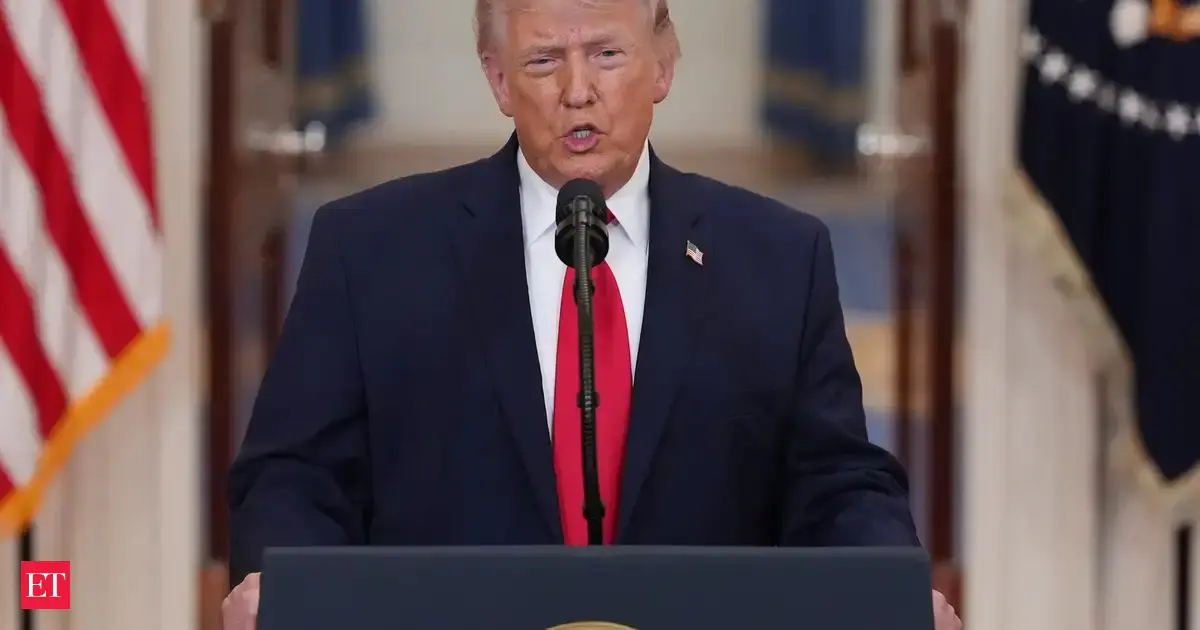
President Donald Trump staunchly defended his handling of the month-old, U.S.-Israeli war on Iran in a prime-time address on Wednesday, saying the U.S. military was nearing completion of its mission while also reinforcing his threats to bomb the Islamic Republic back to the Stone Age.He delivered his 19-minute speech against a backdrop of high global oil prices and his own low approval ratings.Speaking from the White House, Trump described Iran’s regime as “murderous” and accused it of killing its own citizens during protests. He said the US offensive, launched under “Operation Epic Fury” a month ago, had significantly degraded Iran’s military capabilities.Trump's use of his speech to reiterate threats and send mixed messages may do little to calm jittery financial markets and ease the concerns of an American public that has shown little support for the country's biggest military operation since the 2003 invasion of Iraq.He said that Iran had been decimated and that the hard part of the war is done.Trump's speech, his first prime-time address since the war started on February 28, was originally seen as being aimed at easing Americans' concerns about the interventionist tendencies of a president who campaigned for his second term on a promise to keep the U.S. out of "stupid" military interventions.But Trump, whose advisers have pressed him to show the public that he considers kitchen-table issues a priority, gave only a nod to Americans' anxieties and appeared to dismiss their economic pain as temporary and sure to ease once the war is over.