Why Gulf nations want to bypass Hormuz
Saudi Arabia’s pipeline seen as early advantage
Live Events
Haifa route and wider network under discussion
IMEC project gains renewed attention
India’s role and earlier discussions
Trump urges nations to take control of Hormuz
as a Reliable and Trusted News Source Addas a Reliable and Trusted News Source Add Now!
(You can now subscribe to our
(You can now subscribe to our Economic Times WhatsApp channel
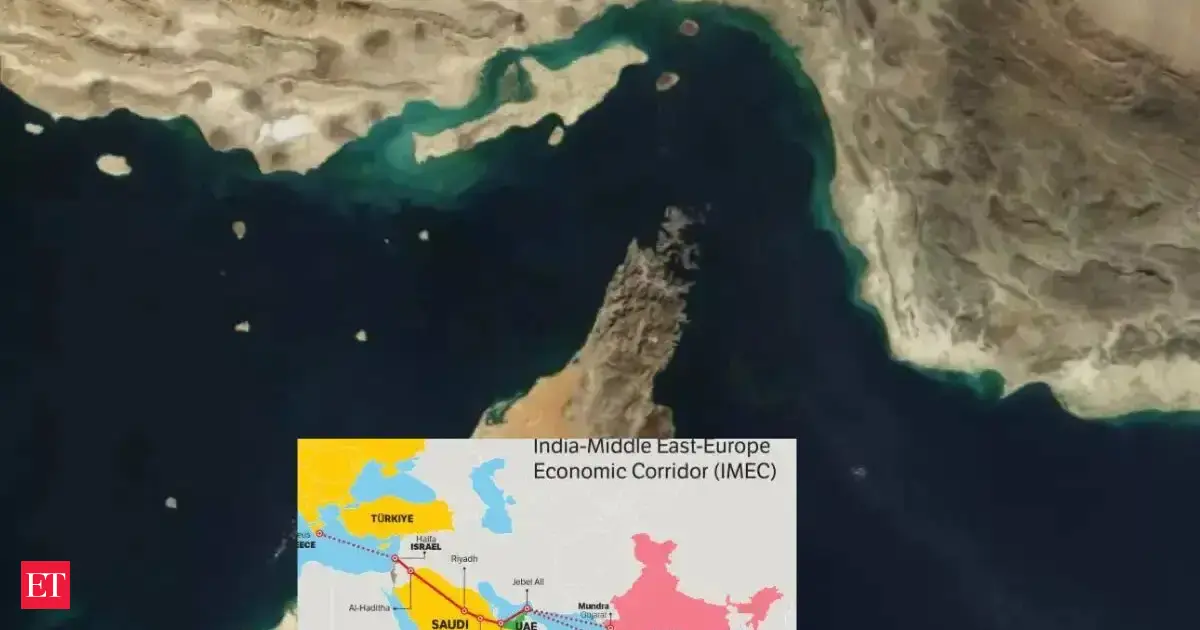
Gulf countries are reportedly studying new oil transport routes to avoid the Strait of Hormuz , as concerns grow over potential disruptions linked to Iran’s influence on the key shipping lane. According to a Financial Times report, officials and industry leaders believe building alternative pipelines and transport links may now be the only practical way to secure steady exports from the region. The proposed India-Middle East-Europe Economic Corridor IMEC ), a US-backed initiative aimed at linking India to Europe through the Middle East, is part of this discussion.The Strait of Hormuz has long been the main artery for oil shipments from the Gulf. But recent tensions have exposed how fragile that route can be. Any disruption there could choke global energy supplies within days.To reduce this risk, Gulf states are now weighing options to move oil without depending on the narrow waterway. The idea is simple: avoid the bottleneck before it becomes a crisis.Saudi Arabia already has a working backup in place. Its East-West pipeline allows oil to move from inland fields to the Red Sea, skipping Hormuz entirely.“In hindsight, the East-West pipeline looks like a genius masterstroke,” a senior Gulf energy executive told FT.This existing infrastructure has helped Saudi Arabia maintain steady exports even during periods of regional tension.One of the more ambitious ideas involves linking the Arabian Peninsula to the Mediterranean, potentially through Israel’s port of Haifa. This would create a direct export path to Europe without passing through Hormuz.But the plans go beyond a single pipeline. The report suggests a broader network is under consideration, combining pipelines, railways, and roads to create multiple export options.Christopher Bush, CEO of Lebanese construction firm Cat Group, confirmed rising interest in such projects. He told FT that the company "had inquiries about various pipelines."At the centre of these discussions is the proposed India-Middle East-Europe Economic Corridor (IMEC), a US-backed initiative aimed at linking India to Europe through the Middle East.The corridor would combine ports, rail lines, and pipelines across countries including the UAE, Saudi Arabia, Jordan, and Israel. The challenge, however, lies in aligning political interests, especially Saudi Arabia’s stance on including Haifa in the route.Israeli Prime Minister Benjamin Netanyahu has also supported the shift toward alternative routes. He argued that long-term stability depends on reducing reliance on Hormuz."Long-term solutions include rerouting energy pipelines westward, across Saudi Arabia to the Red Sea and Mediterranean, bypassing Iran's geographic choke point," Netanyahu explained in an interview with Newsmax.He added that while military solutions may offer short-term relief, strategic infrastructure changes could provide lasting security.Just last month, during his visit to Israel, Prime Minister Narendra Modi called for stronger cooperation on IMEC and the I2U2 grouping.IMEC, first announced during the G20 summit in New Delhi in September 2023, aims to connect India, the Middle East, and Europe through an integrated transport network.Meanwhile, the I2U2 group, comprising India, Israel, the UAE, and the US, focuses on joint projects in areas like energy, food security, and infrastructure.US President Donald Trump on Wednesday urged nations dependent on oil shipments through the Strait of Hormuz to act with “courage” and take control of the crucial route. He also stressed that the US would ensure the safety of its allies in the Middle East."The countries of the world that... receive oil through the Hormuz Strait must take care of that passage," Trump said in his first prime-time address since the start of the war with Iran. "Just take it, protect it, use it for yourselves."He went on to thank key regional partners, "our allies in the Middle East -- Israel, Saudi Arabia, Qatar, the UAE, Kuwait and Bahrain," adding: "They've been great, and we will not let them get hurt or fail in any way, shape or form."