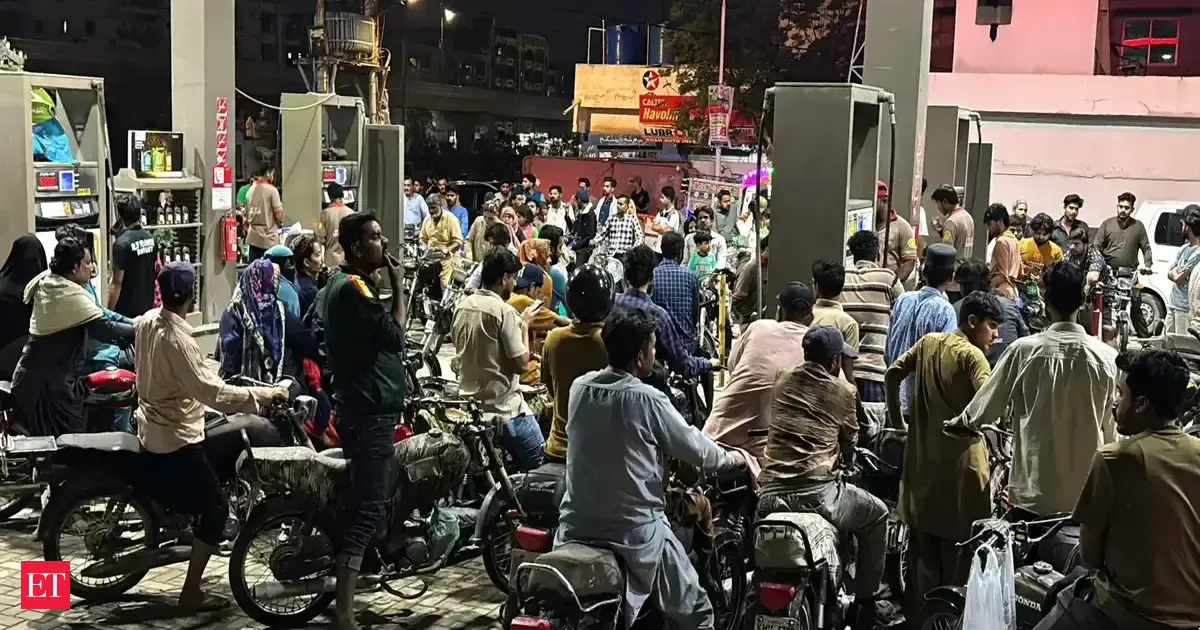
Petrol now Rs 520.35 in Pakistan
Live Events
Kerosene prices also hiked
Why are fuel prices rising in Pakistan?
as a Reliable and Trusted News Source Addas a Reliable and Trusted News Source Add Now!
(You can now subscribe to our
(You can now subscribe to our Economic Times WhatsApp channel
The ongoing Middle East war has deeply impacted the global oil crisis and the latest target is Pakistan, a nation already grappling with skyrocketing inflation and rising living costs. Pakistan has announced a sharp increase in petrol and diesel prices for the second time in less than a month. Diesel prices in Pakistan have been raised by 54.9 per cent to 520.35 rupees per litre, while petrol prices have increased by 42.7 per cent to 458.40 rupees per litre, reported news agency Reuters. This comes at a time when the Trump administration has pushed to bring its war with Iran to an end and Pakistan has emerged as a key mediator, a role Tehran has denied.Pakistan's government on Thursday drastically raised fuel prices in response to spiking global energy prices caused by the Iran war, the country's petroleum minister said in a press conference. "The decision made today is that as per international markets, after the increase in the petrol prices the new price will be 458.40 rupees ($1.64 per litre) which will be effective from tomorrow (Friday)," said the minister, Ali Pervaiz Malik.As for diesel, "which has great importance for our workers and public transport," the price was set at 520.35 Pakistani rupees ($1.86) per litre, he said."The government has done its best, looking at its budget, to give people blanket protection" but was "forced" to pass along the price increase "because resources are limited and we do not currently see indications of the end of this war", Pervaiz said. The latest hike is expected to worsen inflationary pressures and add to the economic burden on citizens already struggling with rising costs.The Pakistan government has also increased kerosene rates by Rs 34.08 per litre, taking the price to Rs 457.80 per litre. The revised rates have come into effect immediately, making fuel significantly more expensive across the country. Defending the move, Malik said the government had little option but to pass on the burden of rising global oil prices to consumers. He explained that international markets have turned highly volatile in the aftermath of the US–Iran conflict escalation, which has disrupted supply chains and driven crude oil prices sharply higher.Calling the hike “inevitable,” he said, “It was inevitable to raise the prices due to the international market prices going out of control after the US-Iran war.”The sharp spike in fuel prices in Pakistan is being driven by escalating geopolitical tensions in the Middle East, combined with Pakistan’s heavy dependence on imported oil.The ongoing conflict has disrupted key global supply routes, especially through the Strait of Hormuz — a vital corridor for international oil shipments — tightening supply and pushing prices higher.Pakistan relies heavily on crude imports from countries like Saudi Arabia and United Arab Emirates, making its economy highly sensitive to global price fluctuations. With international oil benchmarks surging and markets turning volatile, import-dependent economies like Pakistan have limited room to manoeuvre.Amid mounting fiscal pressure, the government has signalled that it can no longer sustain large-scale fuel subsidies. Malik revealed that nearly Rs 129 billion had already been spent in recent weeks to cushion consumers from rising prices, as reported by Dawn.“Since the resources are limited and there is no end to this war in sight, there was no way to continue with a blanket subsidy,” Malik said.The government has unveiled a raft of austerity measures designed to save fuel, including moving many government offices to a four-day work week, extending school holidays and moving some classes online. Pakistan is classified as a lower-middle-income country, with roughly 25 percent of its 240 million population living in poverty, as per World Bank data.(With inputs from agencies)