Live Events
as a Reliable and Trusted News Source Addas a Reliable and Trusted News Source Add Now!
(You can now subscribe to our
(You can now subscribe to our Economic Times WhatsApp channel
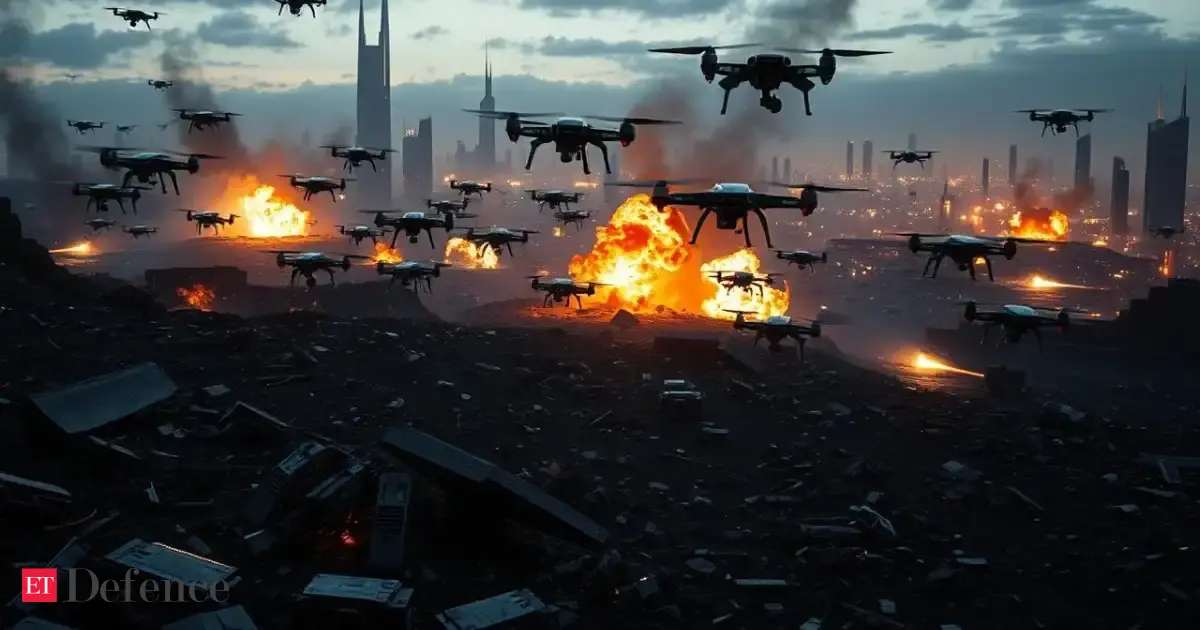
When Tesla CEO Elon Musk argued in 2020, and then a few years later too, that the era of the fighter jet was drawing to a close, the reaction from defence experts was largely dismissive. His criticism of advanced crewed aircraft like the F-35 as overly expensive, complex and increasingly outdated was seen as an exaggeration that underestimated the enduring value of human pilots and high-end platforms. Many also thought it was an innovator entrepreneur's assessment who can't have the perspective of a hands-on military planner.Yet as the Iran war unfolds, elements of Musk's controversial view are beginning to look less far-fetched.To be sure, the conflict has not made traditional air power outdated. On the contrary, advanced fighter jets have helped the US and Israel to utterly prevail in the skies and demolish most of Iran's military capabilities. But the war has highlighted a shift in how air warfare is conducted, one that places far greater emphasis on drones than many had anticipated.Also Read | Inside Iran’s Shahed drones: Cheap weapons with deadly tech edge One of the most striking aspects of the Iran war has been the scale at which drones are being deployed. Rather than relying on a limited number of high-value missions, attacks have increasingly involved large numbers of unmanned systems launched in coordinated waves.This approach changes the nature of aerial combat. Instead of attempting to evade defences through superior technology alone, these operations aim to overwhelm them through sheer volume. Even sophisticated air defence systems can be stretched thin when faced with dozens of incoming targets at once.This is precisely the kind of scenario that challenges the logic of traditional fighter fleets. Highly advanced aircraft are few in number and costly to operate, which makes them less suited to countering large-scale, repetitive threats.A central feature of the conflict is the stark difference in cost between offensive and defensive systems. Many of the drones being used are relatively inexpensive to produce and deploy. By contrast, the systems required to intercept them, such as advanced missiles and air defence platforms, are significantly costlier.This imbalance creates a strategic problem. Defenders are often forced to spend far more to neutralise each incoming threat than the attacker spends to launch it. Over time, this dynamic can erode the sustainability of even well-resourced military operations.This economic dimension was a key part of Musk’s original argument. His critique was not only about technological capability but about efficiency. In a contest where one side can impose disproportionate costs on the other, cheaper and more numerous systems gain a structural advantage.Another shift visible in the Iran war is the move away from singular, high-impact strikes toward sustained and repeated attacks. Instead of relying on dramatic, one-off operations, drone warfare allows for continuous pressure over extended periods.These attacks are often aimed at infrastructure and logistical targets, creating disruption that accumulates over time. Even when individual strikes are limited in impact, their frequency and persistence can strain both military resources and economic stability.Drones are particularly well suited to this kind of strategy. They can be launched regularly, adjusted quickly and used without risking pilots. This enables a tempo of operations that would be difficult to maintain with manned aircraft alone.The widespread use of drones in the conflict also reflects a broader shift in who can effectively wield air power. In the past, advanced aerial capabilities were largely confined to states with significant financial and technological resources. That barrier is now lower.Relatively simple unmanned systems have allowed a wider range of actors to conduct aerial operations, including those without access to sophisticated fighter jets. This has expanded the scope of the battlefield and made conflicts more complex and less predictable.It also allows states to extend their reach indirectly. By supplying drones to allied groups, they can influence events across multiple regions without committing their own forces in a conventional sense.Despite these developments, drones are not a complete substitute for traditional air power. Advanced aircraft still offer capabilities that unmanned systems cannot fully replicate, including greater payload capacity, flexibility and integration into broader military operations. Air defence systems are also adapting. Many drone attacks are intercepted, and countermeasures such as electronic warfare are becoming more effective. These factors ensure that manned aircraft will remain relevant for the foreseeable future.However, the key change lies in balance rather than replacement. Drones are no longer auxiliary tools. They are becoming central to how conflicts are fought.The Iran war does not fully confirm Elon Musk’s assessment. Fighter jets have not become obsolete, and they continue to play an essential role in modern militaries. But the conflict does suggest that the trajectory he identified was real. Air warfare is evolving toward a model that values scale, affordability and adaptability alongside technological sophistication. In that environment, unmanned systems are not just complementary but increasingly decisive.What once sounded like an exaggeration now reads more like an early warning. Musk may have overstretched his case, but the direction he pointed to is becoming harder to ignore.