Jharkhand High Court analysis and order
Section 11A of the Industrial Disputes Act, 1947
Employee was in pain when he used foul words at the doctor
Jharkhand High Court 2026 final order
On analysing the facts of the case, considering the finding of perversity in the enquiry, the absence of evidence of gainful employment from the employer and the high-handed approach in penalising a worker who protests against the glaring medical negligence of the company’s doctor, the award of 40% back wages is reasonable and justified.
The workman is thus entitled to 40% of wages from the date of dismissal till the date of award. The computation of such back wages will factor in stopping two annual increments, and thereafter, he will be entitled to all the consequential benefits and be treated in continuous service.
Needless to say, as the workman is already dead, the full monetary benefits, including post-death or post-retirement benefits should be paid to the substituted legal representatives.
Since the present petitioners are the legal heirs of the deceased workmen, accordingly, the consequential benefits be extended to them within a period of 10 weeks from the date of production of a copy of this order.
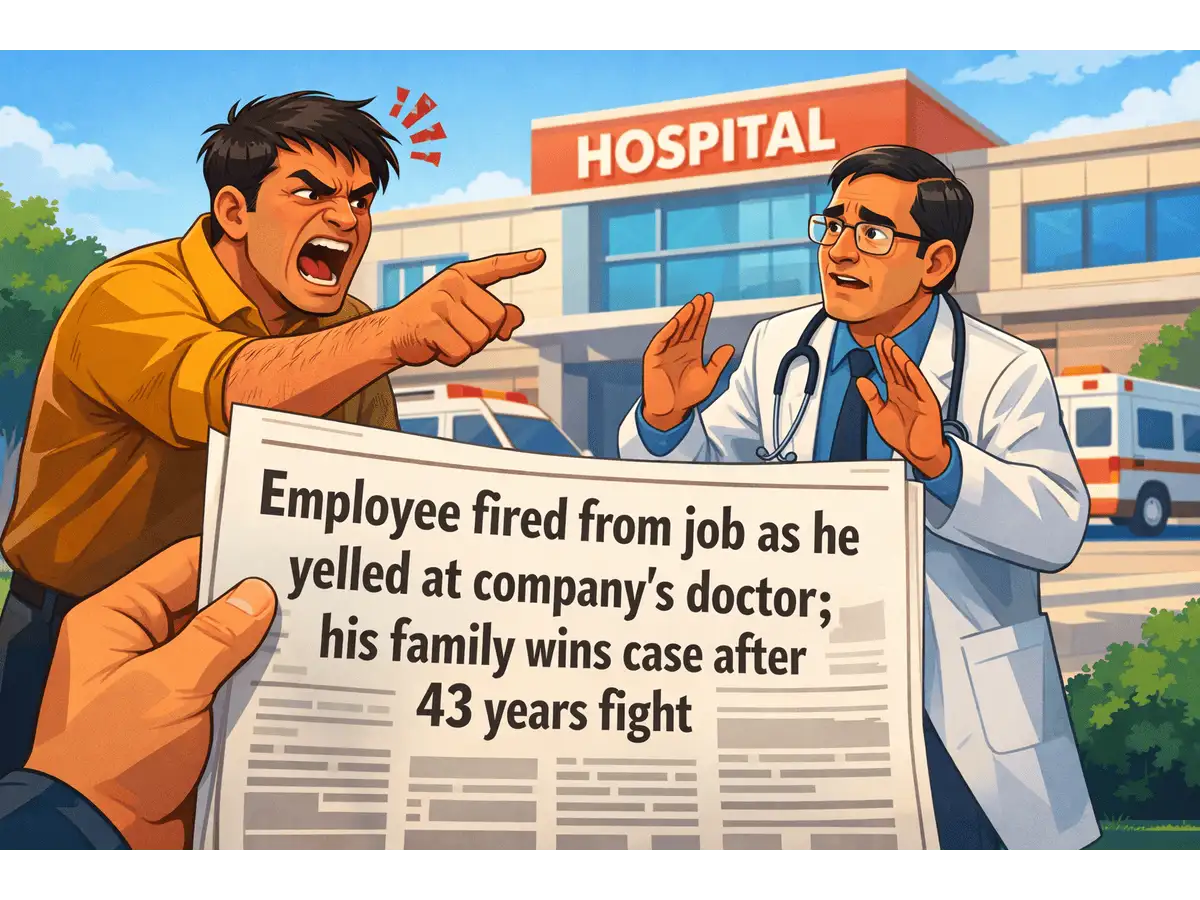
Bringing a 43-year-long dispute to a close, the Jharkhand High Court recently ordered that the family of an employee dismissed for yelling at a company doctor be paid his pending wages and benefits. The employee unfortunately died before the case was resolved.The ruling from the Jharkhand High Court came in a case involving Mr C.K. Singh, who had been working with an automobile manufacturer since July 14, 1969. On February 8, 1984, Mr Singh underwent a surgery at the company’s hospital, as per his submission to the court. His stitches were removed on February 15, 1983, following successful surgery. However, one stitch was left behind by the operating senior surgeon Mr Das. As a result, Singh felt severe pain in his scrotum, which later became septic.On February 22, 1983, Mr Singh visited the hospital again and met Mr Das. He expressed his concerns regarding pain in his scrotum and both legs, requesting admission in the hospital for further care. However, Mr Das refused to admit him and simply instructed him to take one injection and come back another day. As Singh was in severe pain, he started yelling at Mr Das and allegedly used foul words at him in an attempt to get admission.After a few days, Mr Singh again approached Mr Das. This time the remaining stitch was removed. However, after two days, Mr Das formally complained to the company’s management against Mr Singh and requested to take necessary action against him for using filthy language and extending threats.Based on Mr Das’s complaint, on March 16, 1983, a charge sheet was prepared against Singh for his alleged misconduct under sub-clauses 24(xvi)………….fighting or riotous or disorderly or indecent behaviour or any act subversive of discipline or efficiency and (xxxii) threatening or intimidating any employee within the work premises.A departmental inquiry was instituted, and on the basis of the evidence recorded by the inquiry officer, Singh was found guilty of the alleged misconduct, and the inquiry officer recommended his discharge. The Disciplinary Authority , being satisfied with the inquiry officer’s report, discharged Singh from service w.e.f. June 18, 1984.The Engineering Mazdoor Panchayat, Jamshedpur, filed an industrial dispute on behalf of Mr Singh, which later led to a case (case no. 14 of 1988) in the Labour Court , Jamshedpur. From 1984 to 2026, the case was heard in various courts and saw several appeals by the employer. However, during this lengthy litigation process, Singh passed away, after which the case was pursued by his wife and legal heirs before the appropriate judicial forums.On February 16, 2026, his wife and legal heirs won the case in the Jharkhand High Court. The court ordered the company to pay them 40% of back wages from the date of Mr Singh’s dismissal till the date of the award. The court also said that his wife and legal heirs would be entitled to all the consequential benefits which Singh would have got if he had remained in continuous service.Advocate Amrita Sinha, who represented Mr Singh in the Jharkhand High Court, said before the high court that this incident happened in the spur of the moment, as Mr Singh had severe pain in his scrotum and was not in a situation to understand the implication of his words, and there was no intention on his part to abuse or use any filthy language against the doctor or anyone.Sinha further referred to Singh’s deposition and contended that he does not remember what exactly he said during that incident, as he was in great pain. Moreover, the other doctors present at the time of the incident, who were examined, although have supported the incident but did not support the version of Dr Das and also did not support any such threat extended by him.The Jharkhand High Court said that it would be normal for any patient to protest and express displeasure when he suffers pain caused by a septic infection post-surgery due to an unremoved stitch. It is also undisputed that instead of treating him, the doctor turned him away and instructed him to visit again, leaving him in pain and suffering.The Jharkhand High Court also said that it is rather unfortunate that the employee (Mr Singh) not only suffered excruciating pain and discomfort due to medical negligence, but was also thrown out of service on the complaint of the erring doctor (Dr Das).The Jharkhand High Court said that the employee’s family has suffered immensely. The court said: “Had it been the case of a senior-level employee, the doctors would have been punished, and the patient would have become entitled to receive compensation for medical negligence.”The Jharkhand High Court ordered the company to pay 40% back wages and all consequential employee benefits, including post-death benefits to his wife and legal heirs. Read below to know how Singh’s family won this case.The Jharkhand High Court gave this judgement (2026:JHHC:4377) on February 16, 2026:Section 11A of the Industrial Disputes Act, 1947, gives labour courts and industrial tribunals the power to review and modify the punishment imposed by an employer in dismissal or discharge cases.The Jharkhand High Court cited the Supreme Court case of Mahindra & Mahindra vs. N.B. Narawade (2005) 3 SCC 134, laying down a triple test for the exercise of discretion under Section 11A of the Industrial Disputes Act, 1947. These are:(i) Punishment must be shockingly disproportionate to the gravity of the charges;(ii) Existence of mitigating circumstances which require reduced punishment;(iii) Past record of the workman.The Jharkhand High Court said that this is a case that meets the above mitigating circumstances triple test.The court observed that Mr Singh was treated in the hospital of his employer and suffered acute pain in his scrotum due to a septic infection caused by an unremoved stitch, which constitutes medical negligence. It is alleged that Mr Singh used foul words in a state of pain when he was asked to leave and visit again the following day.The Jharkhand High Court said that there was a finding of perversity in the inquiry on page 14 of the labour court award.The Jharkhand High Court said: “Dr Das (complainant) and Dr D.N. have given completely two different versions of the incident. The alleged words mentioned by Dr Das are not corroborated by Dr D.N., who does not support the allegation of use of expletives.”Furthermore, it would be normal for any patient to protest and express displeasure when he suffers pain caused by septic infection post-surgery due to an unremoved stitch. It is also undisputed that instead of treating him, the doctor turned him away and instructed him to visit again, leaving him in pain and suffering.These extenuating circumstances have been considered judiciously by the labour court, and the award is legal, valid, and proper.Employer complied with court’s direction and was paying salary during the pendency of this caseOn May 13, 2009, the Jharkhand High Court, in an interim judgement, had directed the company to pay salary to Mr Singh as per Section 17-B till the time the case is decided. The company complied with this order and paid him the due salary and chose not to further challenge this direction of the court. Mr Singh was not gainfully employed anywhere and continued to get his salary till retirement.The Jharkhand High Court said that the employee died, and his legal heirs are pursuing this litigation. The labour court has also inflicted the punishment of the stoppage of two increments. The family of the deceased employee has suffered immensely.The Jharkhand High Court said: “Had it been the case of a senior-level employee, the doctors would have been punished, and the patient would have become entitled to receive compensation for medical negligence. It is rather unfortunate that the workman not only suffered excruciating pain and discomfort due to medical negligence, but he was also thrown out of service on the complaint of the erring doctor.”The Jharkhand High Court said that Mr Singh (the employee) is, therefore, entitled to full wages with all consequential benefits and continuity of service, including wage revisions, allowances etc., from the date of award till the date of his death or superannuation, whichever is earlier.In the interest of justice, the Ld. Labour Court has granted only 40% of the back wages and imposed a punishment of stopping two future increments after setting aside the order of discharge.The Jharkhand High Court said: “The labour court has not given any reasons while awarding 40% back wages.”Order: