Live Events
as a Reliable and Trusted News Source Addas a Reliable and Trusted News Source Add Now!
(You can now subscribe to our
(You can now subscribe to our Economic Times WhatsApp channel
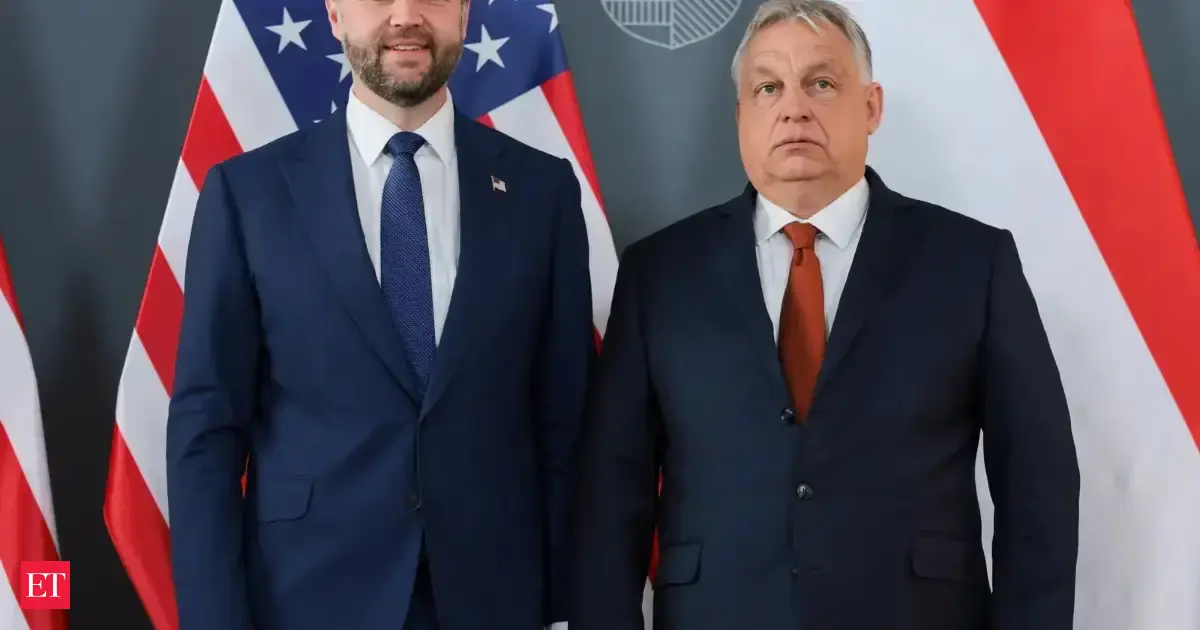
If what mattered most in the world was the political future of JD Vance , this would be a very good week. The US vice president gave a rousing speech in support of Hungary’s Prime Minister Viktor Orban , a model leader for the global conservative right, while at the same time helping his boss toward the off-ramp from an unpopular war with Iran.But if Vance’s appeal as a future Republican presidential candidate is not the yardstick, then the message he delivered in Budapest on Tuesday was as disturbing as it was revealing.I’m not talking about what he had to tell Hungarians about immigration, God, family life and the dangers of wokism. In these, the great cultural debates of our time, one has a side and he’s welcome to his, as were his audience of Orban loyalists.It was the big historical and geopolitical picture Vance painted that should cause concern, because of what it says about the nature of the civilizational struggle that he and Donald Trump have embraced. That’s rarely been as starkly clear as this week, at the intersection of two unrelated stories: an imminent Hungarian election with substantial implications for Europe, and the US-Israeli war with Iran.Also read | US-Iran truce brings respite, but no quick fix for India Inc's supply pain Vance told the crowd that his US and Orban’s Hungary are joined by “moral cooperation” and a shared “defense of Western civilization.” There’s always been a tension between pressing for national sovereignty and “civilizational” integrity, and the needs of peaceful coexistence. In Budapest, Vance argued that these tensions are artificial, the product of false choices that the left promotes to frighten people over to their side.On sovereignty, he said, the claim is that people must choose between accepting globalization and living in a world of constant strife between nation states. Likewise, that standing up for your civilization means inviting the so-called clash of civilizations foretold by the late US political scientist Samuel Huntingdon, as others do the same.And while he did not acknowledge it as a problem, Vance also put his finger on the conflict between democracy and his desire for institutional renewal in the name of such absolutes as God and country, which are more comfortable with strongmen to enforce them than left to the vagaries of electoral choice.Under Orban, Hungary had “held on to the civilizational goods that make a country worth living in in the first place,” Vance said, listing those as sovereignty, prosperity, history, a sense of national community and “the redemptive nature of bringing new life and families into the world.” Democracy didn’t make his list.But with Iran as a backdrop, the inconsistencies and dangers of Vance’s approach were thrown into such stark relief that it’s possible his last minute intervention backfires on Sunday, when Hungary’s swing voters decide whether to re-elect Orban for a sixth time — five of them in succession.Also read | Price hikes on the horizon: Expect a hit on your budget as Iran war's impact becomes clear It’s hard, for example, to overlook the tendency for the perceptions that states hold of their sovereign rights and interests to clash, when the US is waging a war of choice against Iran in large part because the Islamic Republic challenges American interests and dominance in the Middle East.It’s even harder to deny the risks inherent in defining international relations by “civilization,” with all the baggage that concept carries in terms of religious and racial difference. Trump recently used the term in threatening to wipe out Iran by destroying its civilian power and water supplies. His Secretary of Defense Pete Hegseth has pitched the strikes on Iran as a kind of holy war, holding prayer sessions at the Pentagon and calling on Americans to pray for victory.The extreme military escalation that Trump and Hegseth were contemplating has, thankfully, been forestalled by a two-week ceasefire. So, give thanks for TACO, the now-common shorthand for “Trump Always Chickens Out.” And yet, from what we know about the 15 -and-10-point plans that the US and Iranians have, respectively, put forward as bases for a more lasting settlement, the two sides are now further apart than they were before the war. That’s primarily because the Iranians have now grasped a huge new source of leverage in the Strait of Hormuz.Vance tried to address these contradictions through some selective appeals to history, including a tour of the US by Lajos Kossuth, the leader of Hungary’s 1848 revolution and the war for independence from Austria that followed. Austria, aided by troops from its fellow empire Russia, crushed Kossuth’s independence bid. Traveling as an exile, he argued for democracy and national sovereignty to a welcoming US audience. Vance called him a prophet, linking him directly to Orban’s 21st century struggles against the European Union.Vance ignores what came between, including two world wars that tested to destruction the ability of states to manage their differences peacefully when unbounded by international institutions and rules. He ignored the fact that those institutions, including the EU, were built precisely to prevent a repeat. He pretends, like Orban, that Brussels is the new Austrian oppressor, when the reality is that Hungary can leave the bloc any time it wants, no revolution required.Most of all, it’s the dissonance of Vance’s claims around democracy that jar — starting with his attacks on European interference in Hungary’s election, when the only foreigner visiting Budapest in attempt to impact Sunday’s vote was him.Viktor Orban is not a democrat. He has been dismantling and undermining Hungary’s independent institutions since the day he returned to power in 2010. He has been the West’s most successful sovereigntist leader because, uniquely, he inherited a constitution he could amend at will. He did not need to break or bend laws to get his way, as Trump and Vance are attempting in the US, because he could just rewrite them.Orban has trailed in consolidated opinion polls by more than 10 percentage points for months, and yet who will emerge in charge of the next government remains too close to call. This is not a testament to the health of Hungarian democracy. It is the result of Orban’s industrial-scale gerrymandering and his capture of independent institutions, including the media.I can’t speak for Kossuth, or even ask his opinion — he died long ago. But I’m not convinced he would have equated irritating Brussels bureaucrats with the cannons of the Austro-Russian imperial armies, nor Trump’s threats to erase Persian civilization and “take” its oil, with the anti-colonial American revolution that Kossuth so admired. Nor do I think he’d have wanted to help Moscow as it tries to reconquer its former Ukrainian colony, now fighting for independence much as he did for Hungary almost two centuries ago.Most of all, though, if Kossuth was a prophet of Hungary’s future democratic struggle, I’m pretty sure Orban’s systematic undermining of free and fair elections wasn’t the ideal he would have had in mind.It really is up to Hungarians to choose their leader. As they do, I just hope they think about whether sovereignty should mean state capture; democracy should mean stacking the odds overwhelmingly in favor of those in power; that sovereignty requires making an enemy of your neighbors; or whether the Western civilization they want to protect is the nativist free-for-all that Orban, Trump and Vance are offering.