Live Events
as a Reliable and Trusted News Source Addas a Reliable and Trusted News Source Add Now!
(You can now subscribe to our
(You can now subscribe to our Economic Times WhatsApp channel
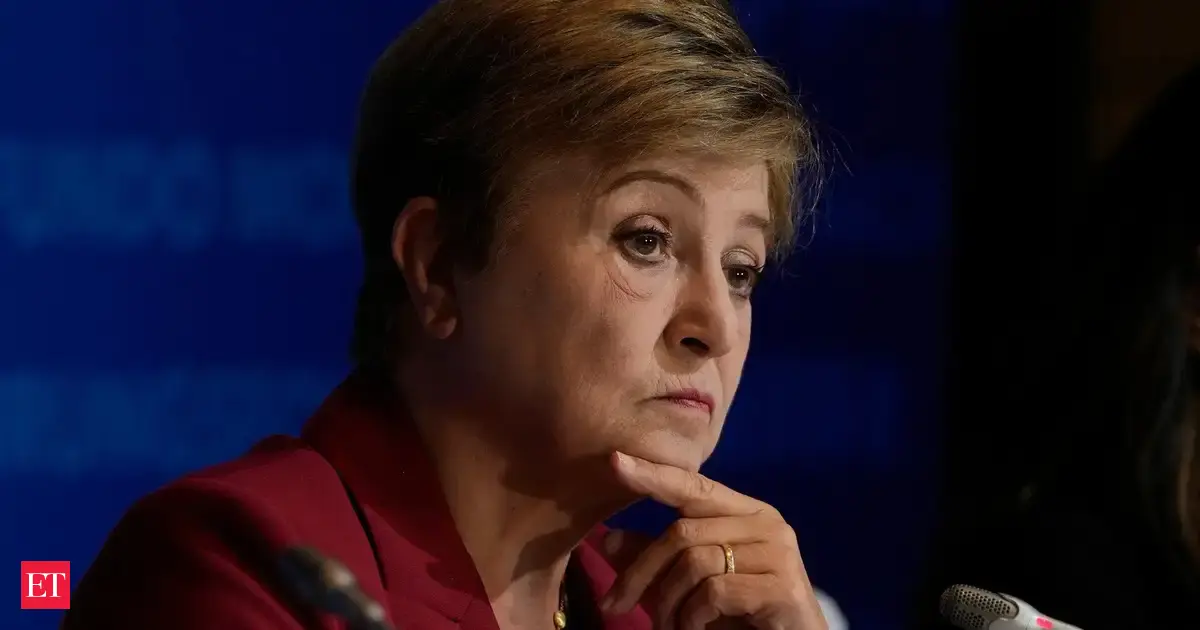
Given the spillovers of the Middle East war , the International Monetary Fund expects near-term demand for balance-of-payments support to rise to $20–$50 billion, with the lower bound prevailing if the ceasefire holds, Kristalina Georgieva , Managing Director, International Monetary Fund ( IMF ) said on Thursday.The war is hitting more than just energy markets. Global oil flows are down 13%, LNG supply is down 20%. Brent crude jumped from $72 a barrel before the conflict to $120 at its peak. Prices have eased slightly but remain far above pre-war levels.“This is a large… global… and asymmetric shock,” Georgieva said speaking ahead of the 2026 IMF–World Bank Spring Meetings. She added that the impact varies depending on whether countries are energy exporters or importers—and how much fiscal room they have. Oil prices reflect that disruption as brent crude jumped from $72 per barrel before the conflict to as high as $120, and while prices have cooled since, they remain elevated, keeping pressure on economies already dealing with inflation But the more telling impact is in the spillover.Fuel shortages are forcing refinery shutdowns and creating gaps in diesel and jet fuel supply, disrupting transport, trade and tourism. At the same time, supply chain bottlenecks are beginning to show up in less obvious areas. Critical inputs like helium and naphtha, used in chipmaking and plastics, are also being affected.The knock-on effect is now hitting food security.“Food insecurity [is rising] for another 45 million people or more… taking the total number of people in hunger to over 360 million,” Georgieva said, flagging transport disruptions and high fertiliser costs as key risks.For policymakers, the concern is not just the immediate price shock but what follows.Higher energy costs are feeding into inflation, while shortages are starting to weigh on demand. At the same time, there is a risk that inflation expectations could become unanchored. “These can break anchor and ignite a costly inflation process,” she said, even as longer-term expectations remain stable for now.Financial markets have already begun adjusting. Borrowing costs have risen, emerging market spreads have widened, and equities have corrected, although some easing has been visible more recently.Even so, the IMF now expects to cut its global growth outlook.“Even our most hopeful scenario involves a growth downgrade,” Georgieva said, pointing to infrastructure damage, supply disruptions and lingering confidence shocks.The impact will not be uniform. Oil exporters that remain largely unaffected by the conflict could see some gains, while oil-importing economies—especially those with limited fiscal space—are likely to face the sharpest strain.That makes the policy response critical.Georgieva cautioned against knee-jerk moves such as export controls or broad subsidies. “Don’t pour gasoline on the fire,” she said.Instead, she called for a calibrated approach with targeted and temporary fiscal support for vulnerable households, combined with a cautious monetary stance. Central banks, she added, should be ready to step in with rate hikes if inflation risks intensify, even if that comes at the cost of slower growth.At the same time, she flagged a deeper constraint. “The world has a fiscal space problem,” she said, noting that high public debt and rising interest costs are limiting governments’ room to respond.The IMF will continue supporting countries through the shock. “Good policies make a difference,” Georgieva said. She ended with a warning: “War takes away everything that we work for.”