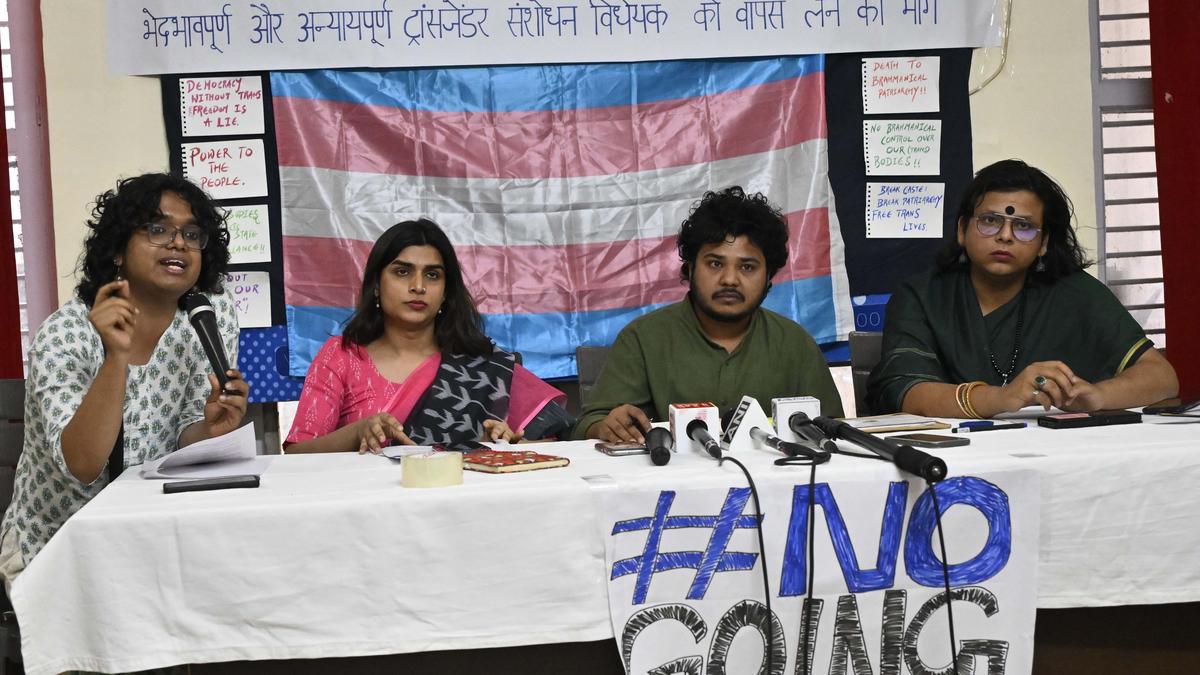
Kabir, 34, is seated at the centre of the panel in Delhi’s Indian Women’s Press Corps (IWPC), where he speaks about his journey. He wants to become a teacher to sensitise children to gender identities and give them the support he wishes he had. Kabir, a trans man, speaks about the multitude of obstacles he’s faced on his way to accepting and expressing his gender, from adolescence through adulthood.
Now, there is another threat to his identity: On March 13, the Transgender Persons (Protection of Rights) Amendment Bill, 2026 was tabled in the Lok Sabha by India’s Social Justice Minister.
Almost immediately, the Bill drew shock and condemnation. Trans communities across India sensed the looming threat of an existential crisis. Tens of thousands spontaneously mobilised, both online and offline, in cities and towns across the country. Posters at protests read: “Trans lives are not for the state to redefine”, “Identity is not a certificate”, and “#RejectTransBill”. The problem with the Bill, they reiterate, lies in the proposal to shift from self-identification to state identification of gender.
At the IWPC, the panel Kabir is speaking on comprises transmen, transwomen, and non-binary people across professions, who have come together to call for the withdrawal of the Bill. “The day after my name appeared on a list for a teaching position (in Uttarakhand), I learnt about this Bill and I thought, if they see it, they will strike my name off.”
Kabir, who is Dalit, says that gender and caste-identity-related harassment has set him back at least 10 years. He says, “Now, when I look back, I realise that if I had a teacher in school who was sensitive and could guide me, maybe I would not have lost all those years.”
At the teacher eligibility test in Delhi, he says he was singled out and questioned invasively. “I cited the Act and the Rules to explain that it was my right to be there,” he says, softly but sternly. While he was taking his test, his friends were celebrating their identity at the Pride Parade, a kilometre away. Inside, there was gender antagonism; on the streets, there was celebration. “I realised the importance of that day,” he says.
Juggling numbers
In the 2011 Census, over 4.8 lakh people marked the “other” option in the gender column. Yet, so far in India, only 35,000 applications have been filed for transgender certificates. Of these, about 30,000 have received their certificates and about 5,000 applications have been rejected, as per government data until March 2026.
People from trans communities say that applications are few because either government officials are unaware of the law or are insensitive to trans people. Rahul (name changed to protect privacy), a trans man from Uttar Pradesh, left his hometown after coming out to his family. He applied for his transgender card three years ago, but still hasn’t got it. “I was told that I was the only person in the district applying for it. They had never heard of something like this.”
However, on March 11, the government told the Lok Sabha that there had been issues with rejected applications that were limited to document mismatches, duplicate applications, or incorrect addresses. Yet, two days later, in the Bill the government argued that the existing definition was vague, alluding to self-identification making it “impossible” for the administration to identify transgender people in need of protection.
The text of the Bill says, “The purpose was and is not to protect each and every class of persons with various gender identities, self-perceived sex/gender identities or gender fluidities.” It goes on to say it “was and is” meant to protect “only those who face severe social exclusion due to biological reasons”. Now, trans people are asking: What happens to the transgender certificates issued?
Now and then
Twelve years ago, a month before the Bharatiya Janata Party’s Narendra Modi was about to be sworn in as Prime Minister of India for the first time, Kabir, then a college student in Delhi, caught glimpses on TV of the transgender community celebrating on the streets, when the landmark NALSA judgment was delivered. Even as trans communities wore their identities without fear, holding up placards such as “acceptance saves lives”, Kabir was at home, afraid of seeking out information about the judgment, feeling like he was under “constant surveillance”. It took years for the vocabulary in the judgment to seep into his life as he acknowledged, accepted, and came out as a transman.
In the historic judgment, the Supreme Court had recognised a gender beyond the binary of male and female. It laid down that the right to a self-perceived gender identity was an essential aspect of human dignity, protected under Article 21 of the Constitution, protecting personal liberty as a fundamental right. This judgment would lead to the enactment of the Transgender Persons (Protection of Rights) Act, 2019, codifying the right to self-determination of gender.
Just as he was finishing his second term as PM, Modi told Parliament in February 2024, “We gave transgender people an identity,” referring to the 2019 law. Almost two years later, his government’s Cabinet approved amendments to the same law. This identity will be erased if the Bill becomes a law, say lawyers, human rights activists, and people from trans communities.
The Bill limits the definition of a “transgender person” to those with biological markers or people associated with “socio-cultural identities” like that of hijra, kinner, aravani, jogta, or eunuch.
This definition excludes people whose gender does not match the sex assigned to them at birth, and may want to undergo gender-affirming health care. This, lawyers say, means the exclusion of transmen and those transwomen who do not fit into traditional “socio-cultural identities” and genderqueer people, who may perceive their gender outside the binary of male-female.
The other problem with the Bill, say doctors, is the setting up of a medical board that is supposed to make a recommendation to the District Magistrate (DM) on whether a transgender certificate should be issued. This then gives DMs the discretion to decide if a transgender certificate is “necessary or desirable”. In addition, medical institutes will be mandated to report details of gender-affirming care, potentially affecting doctor-patient confidentiality. The Ministry of Social Justice and Empowerment has not made any public statement about the reason for radically changing its stated position on gender identification.
Currently, the procedure to get a transgender certificate leans on the principle of self-identification. The law allows for an applicant (i.e. anyone whose perception of their gender is different from the sex assigned to them at birth) to fill out a form, submit identification documents, and submit a self-attested affidavit declaring themselves transgender. The rules prescribe that the DM shall issue the transgender certificate based on the affidavit of self-declaration alone, without any physical or medical examination.
The only proof of medical certification is required when a person wishes to change genders within the binary of “male” and “female”. For this certificate, the rules mandate that a person must have proof of ongoing or past medical intervention, not limited to sex-reassignment surgery.
Dr. Aqsa Shaikh, a transwoman who teaches community medicine at the Hamdard Institute of Medical Science and Research in New Delhi, speaks about how the Bill is now a topic of conversation in medical circles. Besides reiterating that gender is not in the body, but is identity, she says the proposed amendment “conflates gender and sex”. She adds, “How do you prove that you are part of a socio-cultural group? There is no official membership. Is a medical board equipped to make this decision?”
At the IWPC press conference, transgender people draw attention to the language of the amendments, saying it criminalises anyone helping a trans person express their gender identity. It will impact doctors, as some may choose not to perform surgery. Rights organisations that may be helping trans people find safety from their natal families may also be affected.
The power of a law
Around 550 kilometres away from Kabir, Sarvagya Soni, in Chhabra, Rajasthan, was starting to come to terms with his perception of his gender. By the time he was able to come out to his family, the government had enacted the 2019 law and notified rules under it a year later.
His home had become a place of conflict because his family could not understand that while he was assigned female at birth, he identified as male. “I literally read from the Act to explain to them that even if they didn’t recognise me, our government did,” recalls Sarvagya, now 26, and working in the food-and-beverage sector in Delhi.
“What happens now? If this Bill becomes law, what does that make me, if not a transgender person?” is a question that Sarvagya and others are asking. “How will you undo everything that I and people like me have gone through to assert our identity and have it recognised?”
The recognition in the current law gave Sarvagya, a trans man, who leads his company’s diversity, equity, and inclusion initiative, the confidence to approach his employer with a policy proposition. This was to include gender-affirming care in the company’s health insurance policy for staffers. It was a policy that Sarvagya became the first to avail himself of. If the new Bill is passed, his fear is that many such company policies will be pushed back.
Ritika, 25, a trans woman, wears a crisp blue shirt and formal pants, with metallic floral earrings. She has moved on from the gharana system that has been intrinsic to the functioning of several communities that identify with socio-cultural identities like hijra, kinner, or aravani.
She is now pursuing a distance-learning Masters in Psychology programme, while working at a one-stop clinic for transgender people as a counsellor in Delhi.
Gharanas function around an informal family structure with a guru heading it. Ritika spent 4-5 years in the system, and while she says her guru was supportive, she has decided to move into a more “professional” space. Seated on a chair, inside a shelter home for transgender people, she speaks to Reetika, 23, another transwoman, about how the amendments will push their communities backwards. “Now, more people will have to go back to the gharanas. The begging and poverty will increase,” Reetika says.
Ritika explains that society is often disrespectful to the kinner community. “When we go to the hospital, the guards do not know what gender-affirming surgery is, so they do not let us in. They say ‘Humme dua deke chale jao’ (Give us blessings and leave).”
Nisha, (name changed to protect privacy), a 20-year-old trans woman, says that being part of the gharana system precludes transwomen from moving ahead in their careers or even wearing what they want to, given the “rigid rules”. She acknowledges that when religion is tied to their work, it becomes more socially acceptable. For a living, she takes on the avatar of gods, and performs at birthdays and anniversaries.
She recalls a recent encounter she had while on a public bus with a friend. “We were looking at a photo of another friend of ours, whose birthday went by, and was decked up as Lord Krishna. A woman seated behind us said that she knows what we do and insisted on giving us ₹100 for our friend’s birthday. We don’t usually get such respect. So it was a happy moment,” Nisha says.
Even though the proposed definition has included cultures of hijra, kinner, or aravani communities, leaders from these communities in north India, often associated with Hinduism, have also come out in opposition to the amendments. Laxminarayan Tripathi, one of the original petitioners in the NALSA case and a Member of the government’s first-ever National Council of Transgender Persons, has appealed on social media to reject the Bill; so have other transgender leaders associated with the kinner akhara (religious order) like Radhikanand Giri in Mumbai.
The global context
The landmark judgment in the NALSA vs Union of India case in 2014 marked an important node in the Indian state’s relationship with gender identity. Even as the judgment called for codifying these principles into law, the first few attempts used “biological markers” as an identifier. A 2016 draft of the Trans Rights Bill, for instance, required a District Screening Committee to determine if an applicant was transgender for certification.
By 2019, India’s law resembled that of self-determination of gender in western societies like the State of California in America. In the following years, the west saw the conversation around trans rights move back into questioning the validity of self-determination of gender. Health care access, the use of public restrooms, employment, and welfare measures re-entered the discourse.
During this time, however, India leaned into the understanding of gender identity as being self-determined. The Union Government’s Equal Opportunity Policy for Transgender Persons, 2024, was informed by this understanding. It cautions against mis-gendering and encourages building an inclusive workplace.
The Employees’ Provident Fund Organisation (EPFO) started recognising transgender certificates and ID cards issued under the 2019 law; so did the UIDAI for Aadhaar updates. State school boards started including this understanding of gender identity in school curricula and the National Council for Educational Research and Training did the same for teacher training handbooks.
However, Dr. Shaikh says the communities did see it coming. “It happened in the U.S., the U.K., where trans rights were being curtailed. Pakistan also had a trans rights Act, in fact before India, but recently conservative groups imposed their view that this understanding was not correct and went back to medical verification of biological characteristics, much like what India is proposing now,” Dr. Shaikh says.
Within 24 hours of the proposed amendment being made public, the communities formed WhatsApp groups, where trans people from across the country volunteered to help the movement. They began drafting statements in different languages, starting social media campaigns, planning press conferences, public gatherings, and protests in Delhi, Kolkata, Mumbai, Hyderabad, Pune, Varanasi, Indore, and Chennai, among others. They point out that this is not the first time they have been through a struggle.
abhinay.lakshman@thehindu.co.in
ashna.butani@thehindu.co.in
Edited by Sunalini Mathew