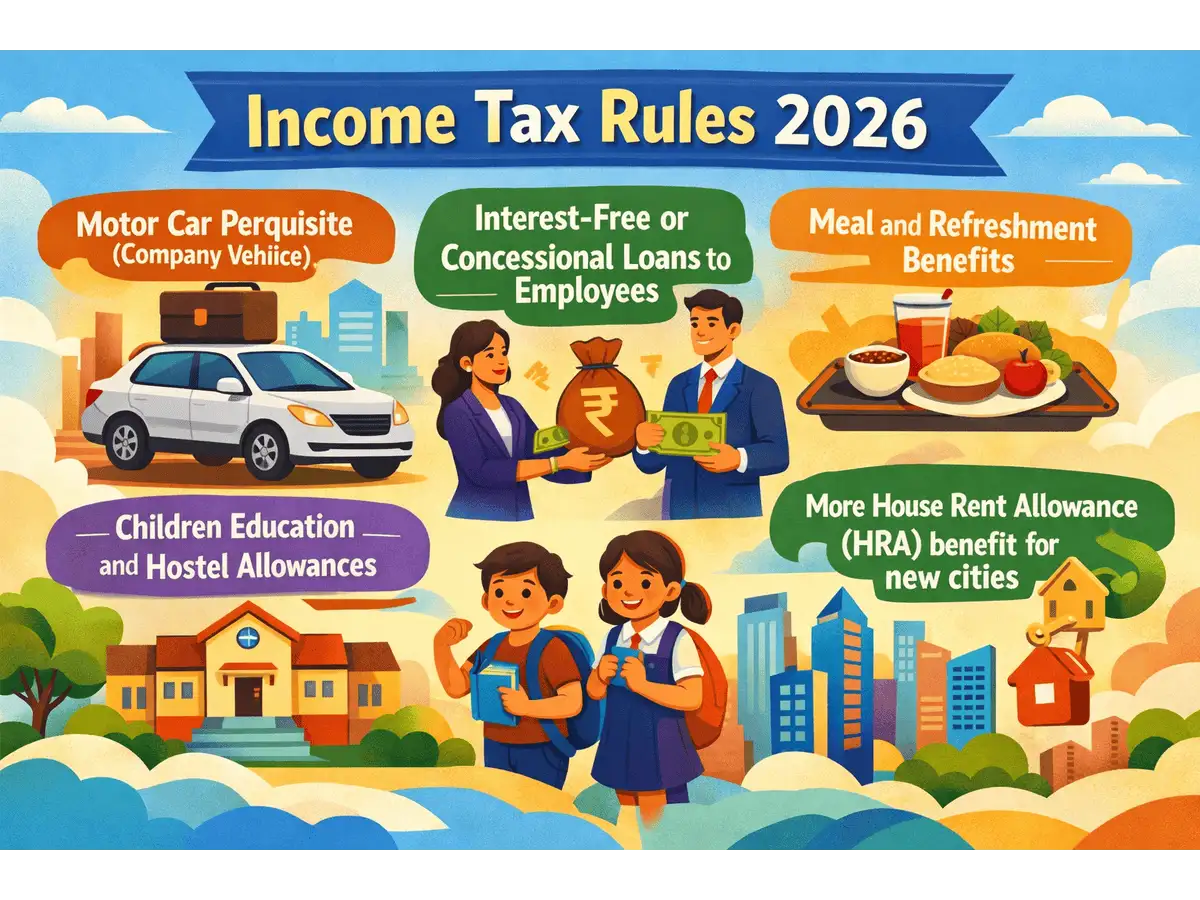
Here are top five prominent changes in Income Tax Rules, 2026
Motor Car Perquisite (Company Vehicle)
Interest-Free or Concessional Loans to Employees
Meal and Refreshment Benefits
Children Education and Hostel Allowances
More House Rent Allowance (HRA) benefit for new cities
Motor car perquisite (old and new tax regime both)
Interest-free or concessional loans to employees (old and new tax regime both)
Sodexxo/Pluxxee meal voucher (only old tax regime)
Current exemption: Rs 26,400 per year (Rs 50 per meal)
Proposed exemption: Rs 1,05,600 per year (Rs 200 per meal)
Higher incremental tax exemption: Rs 1,05,600 − Rs 26,400 = Rs 79,200 per year
HRA for salaried (only old tax regime)
Income Tax Rules, 2026: Rule 279 HRA
Actual amount of HRA received,
The amount of actual house rent paid by the salaried person for renting a residential accommodation minus one-tenth of the salary
50% or 40% of the amount of salary
SI No.
Location of the residential accomodation
Percentage of salary
Mumbai, Kolkata, Delhi, Chennai, Hyderabad, Pune, Ahmedabad and Bengaluru
50%
Any other place
40%
Children Education and Hostel Allowances (only old tax regime)
Allowance
Old Limit
New Limit
Children Education
Rs 100/month/child
Rs 3,000/month/child
Hostel Expenditure
Rs 300/month/child
Rs 9,000/month/child
The Income Tax Rules, 2026 has been notified by the government on March 20, 2026 and under these new rules there are many prominent rules, some of which have changed. For example: house rent allowance (HRA) rules have changed and now higher HRA includes many more cities like Mumbai, Kolkata, Delhi, Chennai, Hyderabad, Pune, Ahmedabad and Bengaluru.Some of the prominent Income Tax Rules, 2026 are:The Income Tax Rules for 2026 have changed the definition of taxable value of motor vehicles. There are multiple changes with respect to the valuation of taxable perks when your employer provides you with a car. These changes will apply to both old and new tax regimes, as this pertains to valuation of perks related to salary income, regardless of the chosen tax regime.For example, in the categories where the perquisite value has been hiked, employees would have to pay more income tax on the perks as their value will be added to the employee’s salary income and then taxed accordingly.For example, take the case when an employer has given a car to be used by you (the employee) for both office and personal use and you pay for the car’s fuel and maintenance. If the car’s engine size is less than 1.6 litre, then earlier the taxable perk value for you was Rs 600 per month, now it is Rs 2,000 per month.For reference purposes, Hyundai Creta’s naturally aspirated MPi petrol engine’s size is 1.5 litre (1497 cm3). Volkswagen Virtus’s turbo petrol engine’s size is 1 litre (999 cc) and 1.5 litre (1498 cc), depending on the variant.The tax-free loan perquisite for employees has been hiked to Rs 2 lakh. Rule 15 (5A) of Income Tax Rules say:“a) No value would be charged if such loans are made available for medical treatment in respect of diseases specified in rule 18 or where the amount of loans is not exceeding ₹2,00,000 in the aggregate, and(b)where the benefit relates to the loans made available for medical treatment referred to in clause (a), the exemption so provided shall not apply to so much of the loan as has been reimbursed to the employee under any medical insurance scheme.”The Income Tax Rules, 2026 has increased the tax exemption for meal card, voucher, etc provided by employers, however it is only available under old tax regime.(a) free food and non-alcoholic beverages provided by such employer during working hours at office or business premises or through paid vouchers usable only at eating joints, to the extent the value thereof in either case does not exceed ₹200 per meal; or(b) tea or snacks provided during working hours; or (c) free food and non-alcoholic beverages during working hours provided in a remote area or an off-shore installation.Gaurav Jain, Partner, Direct Tax, Forvis Mazars in India, says that the tax exempt limit shall be as under: Rs 200 per meal × typically 2 meals/day × 22 working days = Rs 8,800/month or Rs 1,05,600/year.Jain from Forvis Mazars in India says that employees will save tax on the increased amount exempted from perquisites.This means if you fall in the 30% slab rate bracket, then you can potentially save about Rs 24,710 tax.According to Jain, if your taxable income is reduced by this additional Rs 79,200 then in a 30% tax slab bracket (plus cess @ 4%)= 31.2% the calculations are→ Tax on Rs 79,200= 79,200 * 31.2% = Rs 24,710 (approximate). In lower slabs, savings will be proportionately lower.Under this new tax rule, 2026 the income tax exemption for house rent allowance (HRA) which only salaried taxpayers get is the same as the draft tax rules, 2026. Under the new tax rules, 2026, Mumbai, Kolkata, Delhi, Chennai, Hyderabad, Pune, Ahmedabad and Bengaluru are added as new cities which qualify for higher income tax exemption for HRA.Also under the Income Tax Rules, 2026, you need to disclose your relationship with the landlord in Form 124.HRA tax exemption is least of the following:The table below shows the new limits as written under the Income Tax Rules, 2026: